

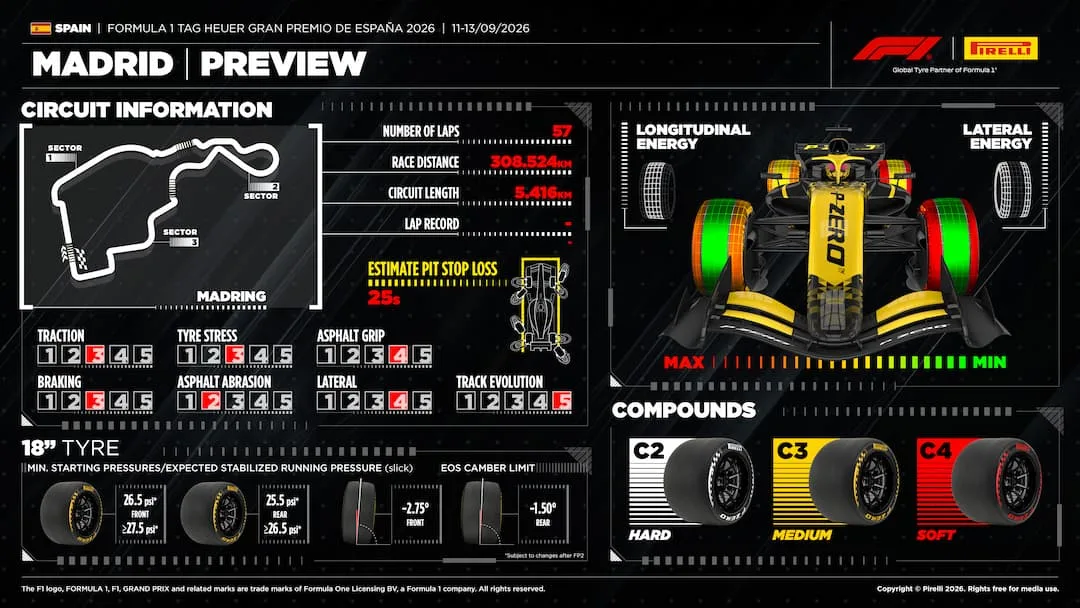
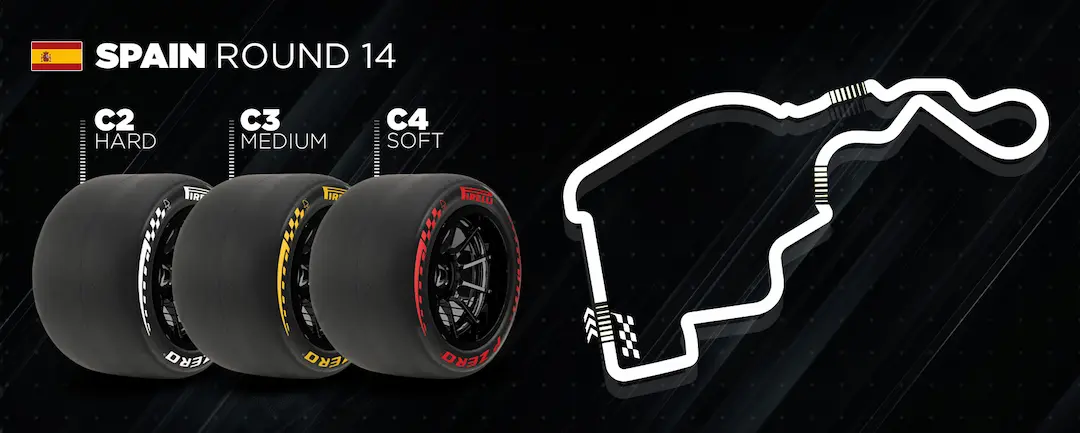
Pirelli brings C2 Hard, C3 Medium and C4 Soft to Madring for Formula 1’s first ever race at the circuit, a nomination built on three years of simulation work and zero laps of actual data. One figure is already clear regardless: Turn 12, the Monumental, a 550-metre corner banked at 24% that generates the highest vertical load anywhere on the 2026 calendar. Everything else waits for Friday.
Key Points: Spanish Grand Prix 2026 Tyre Preview
- Compounds: C2 Hard, C3 Medium, C4 Soft. No prior race or test data exists at Madring, so this nomination is built entirely from simulation and an on-site asphalt survey
- The Monumental, Turn 12, is a 550-metre corner banked at 24%. Pirelli rate it the highest vertical load corner of the 2026 season
- Madring ranks among the five most energy-demanding circuits on the calendar, with lateral forces close to Barcelona and Silverstone
- The asphalt is smooth and low grip. It has been treated with high-pressure water jets pre-weekend, the same method used at Singapore, to clear dust and residue from the new surface
- Pit stop loss has three competing figures: Pirelli’s circuit graphic at 25 seconds, McLaren’s technical preview at +19 seconds (+12 under a Lap 1 Safety Car), and Alpine’s graphic at 22 seconds, marked as an estimate. The spread is wide enough to materially affect the balance between one-stop and two-stop strategies
- No lap record exists. Teams build their entire weekend programme from FP1 onward
Three Compounds, No Track Data
C2, C3 and C4. Hard, Medium, Soft. A mid-range selection sitting in the middle of Pirelli’s five-compound range rather than either extreme, not the raw abrasion pick Suzuka got, not the thermal pick Miami needed. This is a nomination built to cover a layout Pirelli has never seen a car drive competitively. Three years of simulation work sits behind it, stacked on top of an on-site asphalt survey once construction finished. Macro and micro roughness were measured on the ground and folded into a technical briefing shared with every team. That’s the full dataset this compound choice rests on, and no part of it comes from a car turning a competitive lap.
FP1 is where the simulator numbers get checked against what the car does, and Pirelli’s stress ratings get their first real test at the same moment. If degradation on the Soft or Medium runs higher than simulated, compound conservation becomes a live conversation fast, teams banking Hard sets rather than trusting a plan nobody has watched hold up.
The Monumental and the Rest of the Lap
Turn 12, the Monumental, runs 550 metres at a 24% banking angle, and Pirelli have rated it the highest vertical load corner anywhere on the 2026 calendar. Not lateral. Vertical. The banking does that work itself, pressing the tyre into the surface for the length of the corner rather than asking it to resist sideways slip the way a conventional fast bend does. Length is doing as much as angle here. A short banked corner loads a tyre briefly. This one holds that load for over half a kilometre, and Pirelli’s own materials flag a genuine split in how drivers will approach it: commit fully to the banking and carry maximum speed through, or back off slightly to protect the exit and set up the corner that follows. Neither is obviously right before anyone has driven it competitively.
Zoom out and the wider picture backs it up. Madring sits among the five most energy-demanding circuits on the 2026 calendar, lateral forces close to Barcelona and Silverstone, two circuits with decades of tyre data behind them standing in as the nearest available comparison for a track with none of its own.
Pirelli’s stress ratings put a number on the rest of it: 3 out of 5 for traction, tyre stress and braking, 4 out of 5 for asphalt grip and lateral load, 2 out of 5 for asphalt abrasion, and 5 out of 5, the maximum, for track evolution. The track evolution figure is the one to watch. A new surface carrying no rubber changes more across a single weekend than almost anywhere else on the calendar, and the raw asphalt here is smooth and low grip enough that it’s already been treated with high-pressure water jets, the same process used at Singapore, to clear dust and residue before a car turns a lap.
Elevation adds a layer most street-hybrid circuits don’t carry. The highest point of the lap sits at Turn 7, roughly 700 metres above sea level, reached via an 8% gradient and a 10-metre climb from Turn 6, with Turn 2 the lowest point, 26 metres below it. A street section through the exhibition district, a permanent section behind it, a real climb and descent built into the middle, and a banked corner generating the season’s highest vertical load somewhere inside it.

Partner Offer For Coffee Corner Motorsport Readers
Follow F1 with Formula Live Pulse
I use Formula Live Pulse during F1 race weekends to follow live timing, telemetry, gaps, race control and strategy data while covering sessions for Coffee Corner Motorsport.
Save 10% on the annual plan
Use Partner Code TERRYCCM
Download the iOS or Android app, or use the web version. Open the menu, select Partner Code and enter TERRYCCM before purchasing the annual plan.
Affiliate disclosure: I receive a commission if you purchase an eligible Formula Live Pulse annual plan using my partner code. Your 10% discount is unaffected.
The Number Nobody Agrees On
There’s no baseline strategy call to give here, and pretending otherwise wouldn’t be honest to the reader. What can be said with confidence: the mid-range compound trio, the maximum track evolution rating and the total absence of prior running all point toward FP1 and FP2 carrying more weight than usual, and whatever plan looks settled after Friday may not survive Saturday’s added rubber and grip.
One figure needs flagging rather than smoothed over, and it’s now three figures rather than two. Pirelli’s own circuit graphic estimates pit stop loss at 25 seconds. McLaren’s technical preview lists standard pit loss at +19 seconds, with a Lap 1 Safety Car stop costing +12 seconds. Alpine’s own circuit graphic puts it at 22 seconds, and marks that figure as an estimate themselves. Three credible sources, three different numbers, and nothing published yet explains the gap between them.
The range matters more than it looks. A 25-second pit loss pushes strategy toward the one-stop, the cost of stopping twice becomes hard to justify against track position lost. Drop that number toward 19 seconds and a two-stop becomes genuinely competitive, particularly if degradation on the softer compounds runs high enough to make fresher rubber worth the extra stop. Alpine’s own 22-second estimate sits almost exactly between the two, which keeps both routes alive depending on how the rest of the weekend’s data lines up. Every team will be modelling multiple scenarios this week, pit loss weighed against degradation and track evolution together, because none of those inputs are confirmed until cars are actually on the circuit. That’s what makes Friday the most important day of the weekend here, not lap time, but the first point where any of these numbers get tested against reality.
Forty-Five Years Since Jarama
Formula 1 has raced near Madrid before, just not for a long time and not here. Jarama, 30 kilometres from the capital, hosted nine editions of the Spanish Grand Prix between 1968 and 1981. Mario Andretti won there twice, more than anyone else. Lotus leads the constructors’ list at that circuit with four wins. None of it translates to a hybrid street-and-permanent layout on different ground, but it’s the closest thing this weekend has to regional history, and forty-five years is a long gap to bridge on tyre terms.
History exists. Data doesn’t. That’s the position every team is in heading into Friday.
The Podium Cap
Madring’s podium cap, designed by Denis Dekovic for Pirelli Design, carries a white crown with the seven stars of Ursa Major set beneath the peak, one of Madrid’s most recognisable symbols.

Statistics
The Spanish Grand Prix has been held 55 times across five circuits. Michael Schumacher and Lewis Hamilton share the win record on six each. Ferrari leads the constructors’ standings with 12. Useful context for a Grand Prix weekend in Spain. None of it a tyre reference for the circuit this race is run on.
Coffee Corner Take
Madring has never hosted a Grand Prix and whilst I talk about the unknown, I do have some information. I know the Monumental generates more vertical load than any corner F1 will see all season. That’s not a simulation guess. That’s basic geometry, 550 metres at 24% banking, and it will be exactly as demanding on Friday as Pirelli says it is.
Everything else hinges on FP1, including the spread separating three different pit loss estimates. Pirelli say 25 seconds. McLaren say 19. Alpine’s own estimate splits the difference at 22. That’s not a rounding error. It’s the difference between a stop that costs track position and one that doesn’t, on a circuit where nobody has a real reference for the pit lane either. Three credible sources have published three different answers. Friday starts telling us which assumptions survive contact with the actual circuit.
Spanish Grand Prix 2026 Coverage
F1 Spanish Grand Prix 2026 Preview
F1 Spanish Grand Prix 2026 Tyre Preview
F1 Spanish Grand Prix 2026 Media Day
F1 Spanish Grand Prix 2026 Practice
F1 Spanish Grand Prix 2026 Qualifying
F1 Spanish Grand Prix 2026 Tyre Strategy
F1 Spanish Grand Prix 2026 Race Report
Keep CCM Independent & Ad-Free
This coverage was built from the ground up in a shed, entirely fueled by coffee and a passion for racing. If you enjoyed the analysis and want to help keep my motorsport news 100% free and free from annoying pop-up ads, consider supporting the work. Every bit keeps the shed running.
Join the Coffee Corner Motorsport Community
Dive into full race reports, data stories, and behind-the-scenes features
across Formula 1, Formula 2, and beyond.