

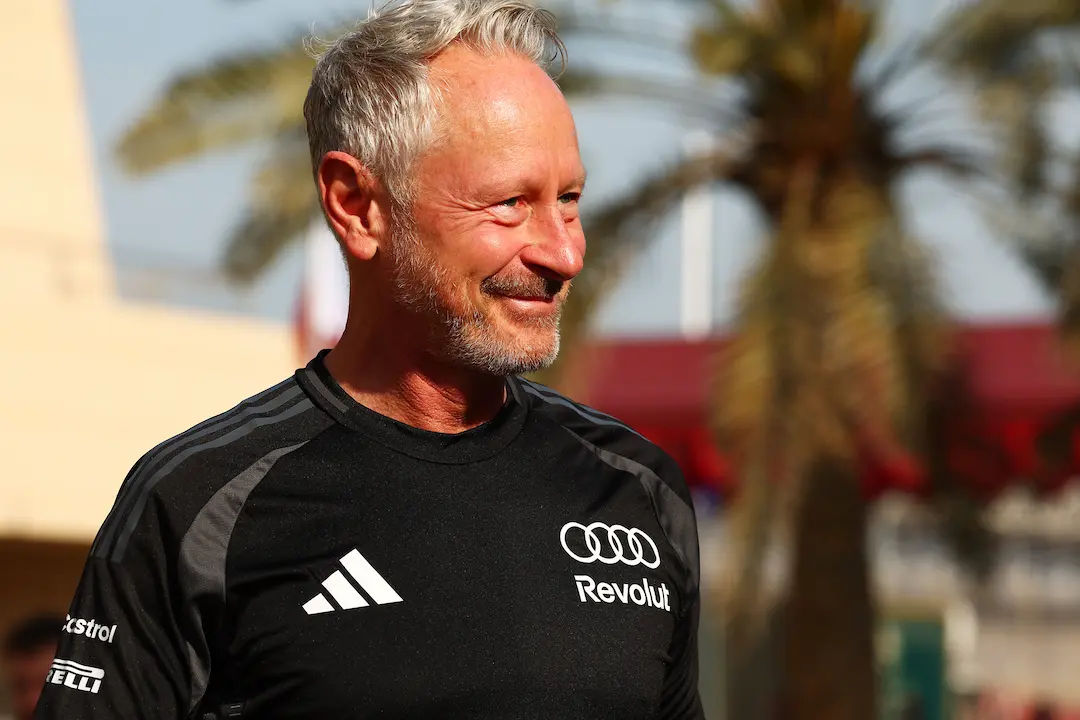
Audi have confirmed Jonathan Wheatley has departed the team with immediate effect, clearing the path for the former Red Bull sporting director to take the team principal role at Aston Martin, where Adrian Newey is stepping back from day-to-day leadership to focus entirely on developing the AMR26. The move ends Wheatley’s tenure at Audi after around twelve months and marks the latest chapter in one of the most turbulent leadership sagas in recent F1 history.
Key Points – Jonathan Wheatley Aston Martin team principal
- Audi confirmed Wheatley’s departure with immediate effect on 20 March 2026, citing personal reasons
- Mattia Binotto assumes the Audi team principal role while a wider structural review takes place
- Aston Martin have not yet issued a formal announcement confirming Wheatley’s arrival
- Garden leave is expected to form part of any agreement given Wheatley moves to a direct rival mid-season
- Newey was always operating as interim team principal, a role never intended to be permanent
- The Honda power unit remains the primary technical crisis, with vibrations causing reliability failures and driver discomfort
What Audi Said
The Audi statement was brief and corporate, but its significance was clear. Wheatley leaving with immediate effect, rather than serving out a notice period, points to an agreement already in place between the two parties rather than a sudden falling out.
“Due to personal reasons, Jonathan Wheatley will depart the team with immediate effect. The team thanks Jonathan for his contribution to the project and wishes him the best for his future endeavours.”
Audi Revolut F1 Team statement, 20 March 2026
Binotto, who had been operating alongside Wheatley in a dual leadership structure, now takes on the team principal title while the organisation defines its longer-term structure. This is the third management restructure at Audi in under two years.
Where Aston Martin Stands – And What Stroll’s Words Actually Say
Aston Martin issued their own statement fifteen minutes after Audi’s, but it did not come from a spokesperson. It came from Lawrence Stroll himself. That choice matters. Teams use holding statements for speculation. Owners speak when something is about to change.
“We do things differently here, and while we don’t currently adopt the traditional team principal role that you see elsewhere, it is by design. As the most successful engineer in the history of the sport, Adrian’s primary focus is on the strategic and technical leadership where he excels. He is supported by a highly skilled senior leadership team to deliver on all aspects of the business, both at the campus and trackside. We are regularly approached by senior executives of other teams who wish to join Aston Martin Aramco, but in keeping with our policy, we do not comment on rumour and speculation.”
Lawrence Stroll, Aston Martin chairman
Read that carefully. Stroll does not use the words “team principal” in relation to Newey once. Yesterday’s official statement explicitly said “Adrian Newey continues to lead the team as Team Principal and Managing Technical Partner.” Today Stroll describes Newey’s role in the language he was originally hired under: strategic and technical leadership. Managing technical partner language, not team principal language.
He is not defending Newey as TP. He is reframing Newey back into his natural role while the official position technically still stands. The path is being cleared in public, through careful wording, ahead of a formal announcement. Stroll also confirms that Aston Martin are “regularly approached by senior executives of other teams who wish to join.” Present tense. That is not a denial of the Wheatley approach. It is an acknowledgement of it dressed as a compliment to the team.
The delay in any formal Aston Martin announcement is explained by sequencing. Wheatley had to formally leave Audi before any deal could be confirmed publicly. That step has now happened. The announcement follows when personal terms are finalised.
The Garden Leave Question
Do not expect Wheatley to be in position before the Japanese Grand Prix. Possibly not before Miami either. Garden leave may still form part of the process given the move to a direct rival mid-season, though Wheatley’s immediate exit points towards a cleaner separation than is typical in these situations.
The process is following its course and none of it is being rushed publicly by either party.
Why Wheatley – The Structural Logic
Newey is one of the most successful car designers in the history of the sport. He is not, by his own admission, a natural team principal. The dual role was a stopgap created by circumstance when Cowell’s relationship with Newey broke down, not a long-term plan. What Aston Martin need is someone who can run the race team operationally, face the media, manage the paddock, and leave Newey free to focus on making the AMR26 fast.
Wheatley spent twenty years doing exactly that at Red Bull. He was not the headline name. He was the person who made everything around the headline names work. What he brought to Milton Keynes was operational structure, strategic discipline, a forensic knowledge of the sporting regulations, and a fierce competitive edge that sits beneath a composed exterior. Red Bull won because the cars were exceptional. They also won because the operation around those cars was relentlessly well run. That was Wheatley’s contribution.
Crucially, this is not a partnership being built from scratch. Newey and Wheatley know each other. They spent those two decades together at Red Bull, through two distinct eras of dominance, building the kind of working relationship that does not need to be explained or established. They already know how each other operates, what each other needs, and where the boundaries are. That shared history is something no other candidate on Aston Martin’s list could offer.
At Audi, Wheatley showed he could step up from sporting director to team principal and bring that same structure and discipline to a project being built from the ground up. The challenge at Aston Martin is different but the requirement is the same: impose order, create accountability, and build the kind of operational foundation that lets the technical people do their best work. That is what Wheatley does.
The one complication, as The Race noted on Friday, is authority structure. Aston Martin cannot offer a team principal the kind of freedom they might enjoy elsewhere, because the real power in the team sits above the TP role. Newey holds a minority shareholding and has direct access to Stroll. Whoever takes the team principal title operates within that structure, not above it. It is understood to be one of the reasons several candidates declined before Wheatley emerged as the lead target. For Wheatley, who spent twenty years operating effectively within a strong hierarchy at Red Bull, that dynamic may be far less of a deterrent than it would be for others.
Aston Martin have cycled through Otmar Szafnauer, Mike Krack, Andy Cowell and Adrian Newey as team principal in the last five years. Wheatley would be the fifth. Some consistency at the top is not just desirable at this point. It is essential.
The Cost Cap – Possible Avenues Worth Examining
The exact financial structure behind Aston Martin’s senior appointments has not been confirmed by the team. What follows is an analysis of how the FIA Financial Regulations Section D Issue 05 could apply, based on the most likely structuring of these roles. It is informed analysis grounded in the actual regulation text, not confirmed fact.
- The Excluded Persons Rule. Under Article D5.1.1.d, the three highest-paid personnel at any team are classified as Excluded Persons, sitting entirely outside the cost cap. These three slots are dynamic, subject to FIA audit, and determined by actual earnings including salary, bonuses and termination benefits, rather than job title.
- The Big Three. If Adrian Newey, Enrico Cardile and Jonathan Wheatley prove to be the three highest earners for the reporting period, none of their salaries will count toward the $215 million cap. However, if Wheatley’s package ranks fourth rather than third, he falls inside the cap, displacing whoever takes the third slot. The position shifts with actual earnings, not assumptions about seniority.
- Zero Transfer Fees. Wheatley’s immediate departure strongly suggests there is no buyout or transfer fee, removing any acquisition cost from the cost cap equation entirely. Aston Martin only needs to manage his ongoing salary.
- The Power Unit Cap Avenue. F1 operates a separate $130 million cost cap for Power Unit Manufacturers under Article D1.6.1. If Andy Cowell’s role as chief strategy officer is classified as Directly Attributable to power unit supply activities due to his focus on the Honda, Aramco and Valvoline relationships, his costs could theoretically shift from Aston Martin’s team cap to Honda’s separate cap entirely. His costs would not disappear from the system but would no longer count against Aston Martin’s $215 million envelope. The bar for that classification is high and depends on how his remit is formally defined. It is a possible avenue, not a confirmed outcome.
- The Mike Krack Question. Krack’s current employment status remains unaddressed publicly. If still employed as chief trackside officer his salary sits inside the cap, adding another variable to the equation.
What the regulations make possible, if appointments are structured optimally, is a senior leadership group where the majority of the highest-cost individuals sit outside the regulated spending envelope. The cost cap limits performance spending. It does not limit how many senior figures a team can employ if the structure is built to use the available exclusions correctly.
The Bigger Picture at Aston Martin
The leadership instability sits alongside a technical crisis that is not going away quickly. Honda have admitted they do not yet know the source of the vibrations affecting the AMR26. The power unit cannot be run at its full electrical deployment limit. Alonso described the experience of driving the car in China plainly.
“At one point, from lap 20 to 35, I was struggling a little bit to feel my hands and my feet. We were one lap behind, we were last. It was probably no point to keep on going.”
Fernando Alonso, Chinese Grand Prix
Cowell is now focused on the three-way relationship between Aston Martin, Honda and Aramco. Newey, once freed from the team principal title, returns to leading technical development. Wheatley, when he arrives, takes on operational and trackside leadership. On paper it is the cleanest structure Aston Martin have had in years. Getting there has been anything but clean.
The facts are what they are. What matters now is what you make of them.
Coffee Corner Take
Lawrence Stroll will not stop until he has what he wants. There is something almost Thanos-like about the way he collects talent, one piece at a time, convinced that when the set is complete the result is inevitable. Newey. Cardile. Cowell. Now Wheatley. Each one undeniably world class. Each one a statement of intent.
But the question that keeps getting louder is whether Aston Martin are becoming F1’s version of a galacticos project. Real Madrid did it. Barcelona did it. Teams built entirely on individual brilliance that somehow struggled to function as a collective. You cannot look at any single person in that Silverstone building and question their credentials. You can absolutely question whether the sum of those parts is adding up to anything.
Wheatley is the right hire for a specific reason. He has been there. He has done it. He understands what it actually takes to win at the highest level, not in theory but in practice, across two decades of doing it at Red Bull. If anyone can walk into that building and make the pieces fit, it is him. That is not a small thing.
But here is the problem. Aston Martin’s issues right now go deeper than a team principal. A power unit that vibrates so violently it risks nerve damage. A car that has not finished a race in two rounds. A Honda partnership that admitted publicly it does not yet know what is causing the problem. A team principal change does not fix any of that. Wheatley cannot tune a power unit from the pitwall.
And then there is the pattern. Every time something is not working at Aston Martin, Stroll pulls a lever. A new face. A new title. A new structure. It looks less like a plan and more like a reaction. The trigger gets pulled before the dust settles from the last shot. That is not how you build a championship team. That is how you build an expensive carousel.
Wheatley deserves the chance to prove this move is different. Maybe the combination of him and Newey, two people who already know how to win together, is the thing that finally makes this project click. But until the AMR26 finishes a race, and until Honda find those vibrations, the leadership structure is decoration on a house that still needs its foundations fixed.
BBC Sport
Motorsport.com
The Race
Autosport
Sky Sports F1
ESPN
FIA 2026 Financial Regulations Section D, Issue 05 (27 February 2026)
Join the Coffee Corner Motorsport Community
Dive into full race reports, data stories, and behind-the-scenes features
across Formula 1, Formula 2, and beyond.
If this helped, you can support this work by buying me a coffee.