

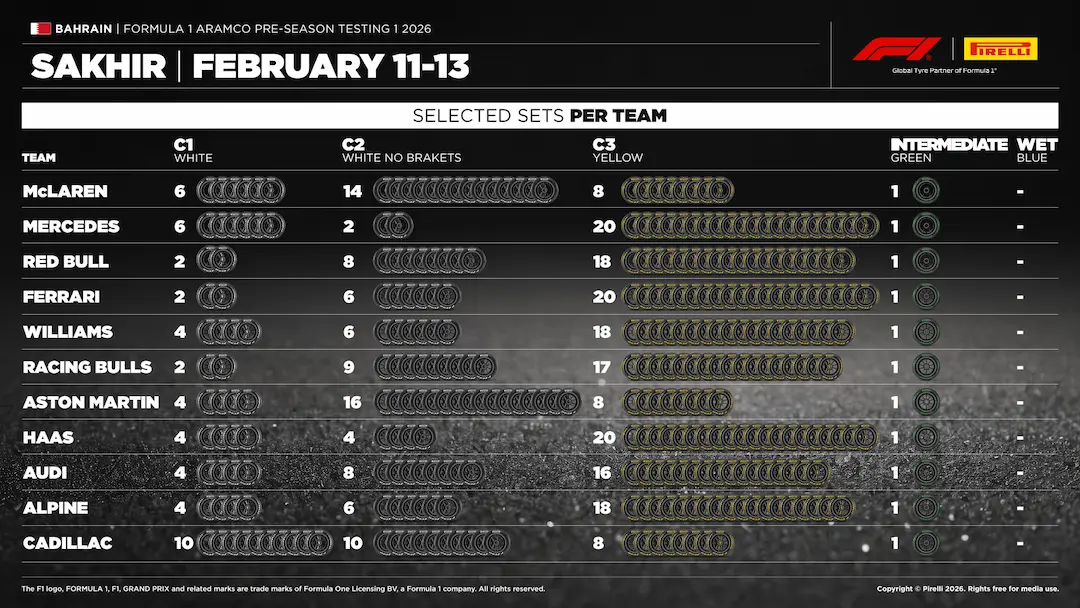
With car launch season almost complete and the Barcelona shakedown now done and dusted, attention turns to the next phase of preparation for the 2026 campaign as official pre-season testing begins in Bahrain. Teams have six days of running across two sessions to learn about cars built entirely to new regulations, with no carry-over parts and limited real-world reference beyond simulation. Bahrain Pre-Season Testing Tyres Pirelli defines the opening phase in Sakhir, where the focus is deliberately narrowed. With Pirelli restricting running to the C1, C2 and C3 compounds only, the first test is about building baselines, validating correlation, and stripping away variables before performance freedom arrives later in the month.

Key Points – Bahrain Pre-Season Testing Tyres Pirelli
- Establish aerodynamic balance without tyre masking
- Study ride-height sensitivity under load
- Assess rear stability through traction zones
- Confirm long-run repeatability across fuel states
Why Pirelli Have Narrowed the Range
The absence of the softer compounds is deliberate.
C1, C2 and C3 sit in the most stable part of Pirelli’s range. They warm progressively, tolerate load variation, and deliver repeatable data across longer runs. That makes them ideal for early-phase testing, where teams are validating aero maps, suspension behaviour, cooling systems, and power unit integration rather than searching for peak grip.
The C1 provides the reference.
The C2 fills the working window.
The C3 introduces sensitivity without exaggeration.
This phase is about removing noise before interpretation begins.
Bahrain As A Reference Circuit
Bahrain remains rear-limited by nature. Heavy traction zones punish instability quickly. Long braking phases load the front axle. Thermal degradation exists, but only when drivers push beyond the test programme.
That makes Bahrain useful, but dangerous.
Fast laps here rarely tell the truth. Consistency does. A car that repeats within a narrow window across fuel loads is learning more than one that spikes a headline time and disappears. Add in the wind, which can make a huge difference around an open circuit like this, and while Bahrain remains familiar, the elements introduce an unknown factor from session to session.
Compound Identification And Test-Only Markings
For the first test, compound identification is simplified but unconventional.
- C1 and C2: white logos
- C3: yellow logos and banding
- Chequered flag banding: C1, C3, C5
- No banding: C2, C4
Over the next three days, when only the C1, C2 and C3 will be in use, there will be two sets with white markings on them and one with yellow. The C1 and C2 can be identified because the latter will not have any banding, and the C3 will have yellow marking and banding. This identification system is only in use for these tests and will not be seen on race weekends.
Teams will know exactly what they are running. From the outside, assumptions will be easier to make than conclusions which could be confusing for the viewers at home but it’s sure to add confusion when most of us are used to the red, yellow and white structure.
What Teams Are Actually Testing
This phase is not about performance ranking at all.
For this phase, it’s about one thing, and that’s correlation. This test is about checking whether what the car produces in the wind tunnel and CFD is what the sensors actually see on the Bahrain asphalt. Without that the teams are lost.
Teams will lean on the harder compounds to:
- establish aerodynamic balance without tyre masking
- study ride-height sensitivity under load
- assess rear stability through traction zones
- confirm long-run repeatability across fuel states
The C3 will appear in short, controlled runs. Enough to understand behaviour. Not enough to chase meaning.
The intermediate allocation exists as insurance, not intent. These will realistically not be used at all in the Bahrain desert.
Coffee Corner Take
Pre-season testing doesn’t reward optimism. It rewards discipline.
Bahrain will produce lap times that mean very little and tyre behaviour that means everything. The teams that come out looking quickest rarely learn the most. The teams that leave with clean correlation, stable references, and a clear understanding of how their car behaves on the hardest tyres usually set themselves up for the season, even if the timing screens never show it.
That’s why this C1–C3 restriction matters. It strips away comfort. It removes the temptation to chase a headline run. It forces teams to confront balance, traction, and thermal control without a soft compound masking the weaknesses underneath.
Cars that slide on the C2 here will slide worse later. Cars that struggle to keep the rear stable through long runs in Bahrain will not fix that with upgrades alone. This is where habits form. This is where engineers decide whether to trust the numbers they already have or start questioning them.
The lap time will come. It always does. But teams that get this phase wrong don’t lose Bahrain. They lose the first third of the season trying to unlearn what they thought they understood. That’s what this test is really for.
Join the Coffee Corner Motorsport Community
Dive into full race reports, data stories, and behind-the-scenes features
across Formula 1, Formula 2, and beyond.
If this helped, you can support this work by buying me a coffee.