


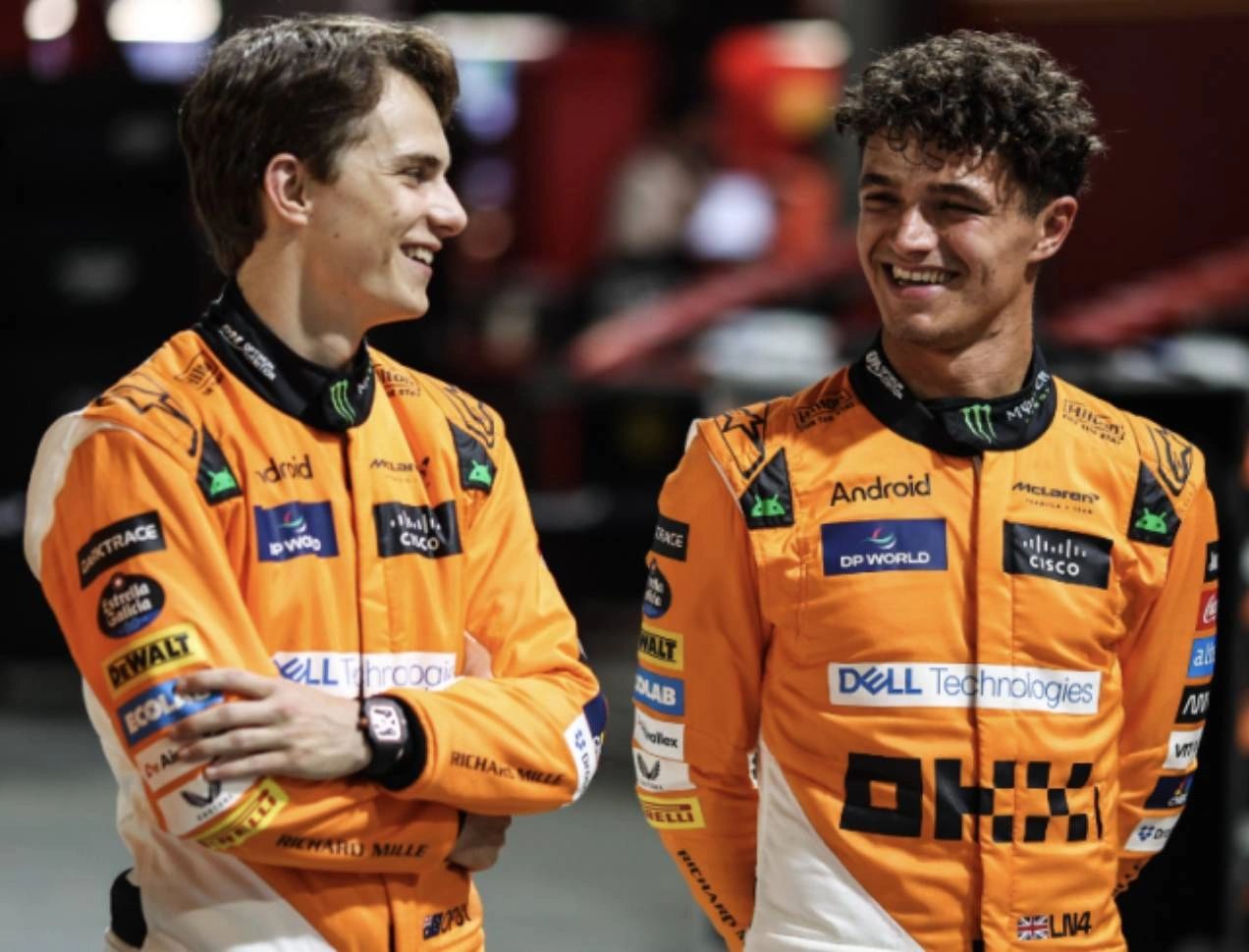
For months, McLaren played the balancing act—no number one driver. There is no need for team orders, a carefully managed rivalry between two of the sharpest operators on the grid. But in Montreal, the moment everyone knew was coming finally arrived — Lando Norris and Oscar Piastri collided. And it’s McLaren who paid the price.
The clash was subtle, almost understated. But its consequences were not.
With just a few laps to go and fourth place on the line, Norris got a stronger exit out of the hairpin and pulled alongside Piastri, misjudged the closing speed, tagging the rear of his teammate’s car.
Norris was out. Piastri held on for fourth place after a precautionary pit stop under the Safety Car. And just like that, the fragile harmony inside McLaren collapsed under the weight of championship ambition and two drivers who refuse to settle for anything but first place in the team.
A Clash That Was Always Coming
The signs were already there. Quiet tension building all season. Strategic jostling in previous rounds. Sharp elbows in Miami. McLaren knew this day would come. Zak Brown even said so before the weekend: “It’s definitely a matter of when, not if.”
Now, when has arrived — and the fallout is real.
Andrea Stella didn’t mince words in the aftermath. “We never want to see the two McLarens having contact. This situation is not acceptable,” the team principal told F1 TV.
But he stopped short of issuing punishment or restructuring the team dynamic.
“It was a misjudgement,” he said of Norris’s move. “If Lando had a different reaction, then there would have been serious conversations. But he owned it immediately.”
And he did. Norris apologised publicly, accepting full responsibility and describing it as a “misjudgement” under pressure. The stewards agreed, handing him a five-second penalty — a symbolic blow, given that his race was already over.
Bigger Than Just the Drivers’ Table
But it wasn’t just Norris who paid. The collision cost McLaren what could have been another dominant double-point result — a rare slip in a season where they’ve otherwise been relentless.
Right now, McLaren sits firmly atop the Constructors’ Championship, leading the pack with a significant margin. Fast cars, sharp strategy, and arguably the strongest driver pairing on the grid have made them the benchmark. But moments like Montreal can chip away at even the most significant margins.
Piastri salvaged fourth. Norris left empty-handed. That’s a 10-point swing to their rivals, a dent, not a disaster. But if this happens again and again, those dents become structural. They are lucky that their title challengers are facing their own issues at the moment.
History doesn’t look kindly on teams that let their title challengers take points off each other. From Senna and Prost to Hamilton and Rosberg, the internal battles often end in burnout. In modern F1, Constructors’ Championships are won through cohesion. Two fast cars only matter if they make it to the finish.
If Montreal becomes a pattern, McLaren’s lead won’t be enough.
What It Means for the Title Fight
Norris’s retirement hands an even bigger championship lead to Piastri, who now sits comfortably ahead after five wins and nine podiums in ten races. Norris, despite a strong pace and two victories, finds himself playing catch-up and paying the cost of one small error in judgment.
“He paid a price in the championship,” Stella noted. “But we appreciate how he handled it. We reset and go again.”
That’s the line for now. But it doesn’t erase what happened. In one flash of carbon fibre, McLaren’s dream scenario, two drivers pushing each other without pushing too far tilted into something more complicated.
Piastri, as ever, was measured after the race. He avoided any inflammatory comments, aware that he’ll likely find himself in the same position soon enough. Because this is what McLaren signed up for: two title contenders in equal machinery, racing for themselves as much as for the team, and that is where the fundamental issues lie.
No Number One, Still
So what now?
Despite the damage, both literal and metaphorical, there are no plans to shift the structure. No team orders. No de facto leader. Stella made that clear. “It doesn’t change things,” he said. “The principles stay the same.”
That stance mirrors what McLaren coined last season as the ‘Papaya Rules’ a light-touch code that let Norris and Piastri race freely, so long as it was clean. It worked then because podiums were rare, and cooperation made sense. But this year, the dynamic is different. There are wins on the line. Pole positions. A world championship.
And now, the same rules are being tested in a much higher-stakes environment.
Zak Brown echoed the usual calm online, praising both drivers for their honesty and focus. “Appreciate the candor, Lando. Solid race Oscar. We learn. We go again.”
But there’s no escaping the subtext. A line has been crossed. And even if it was accidental, it’s exposed the fragility of McLaren’s open-driver policy. Because when two racers are told they’re equals and a championship is on the line, you can’t rely on mutual restraint forever.
Can Two Number Ones Really Work?
There are still 14 races left. And it’s clear now: McLaren’s greatest threat to winning either championship may not come from Red Bull, Ferrari, or Mercedes. It may come from within.
The Norris–Piastri partnership was always built on a tension that needed to be perfectly balanced. That balance just cracked. And if it fractures again, one driver won’t just lose a race. McLaren could lose everything.
But the bigger question lingers beyond this season: Can McLaren really sustain two number-one-calibre drivers long-term?
Both Norris and Piastri are locked into multi-year contracts. Both are young, hungry, and title-ready. And both, by now, rightly believe they should be the one the team backs. That’s the dilemma. Because what works when you’re chasing podiums and picking up the odd win, but it doesn’t always work when you’re fighting for championships.
Norris has been the heart of McLaren’s resurgence, the driver who stayed loyal through rebuilds when the team was finding a way back to the top. But Piastri is proving he’s not here to play second fiddle. He’s already outscoring Norris and may end the year with a championship to his name, which would change the dynamics and relationship even more.
McLaren might be celebrating now, but at some point — whether it’s this year or next — the team will have to choose between full parity or a defined pecking order. Because when both drivers want the crown, someone eventually has to wear it.