


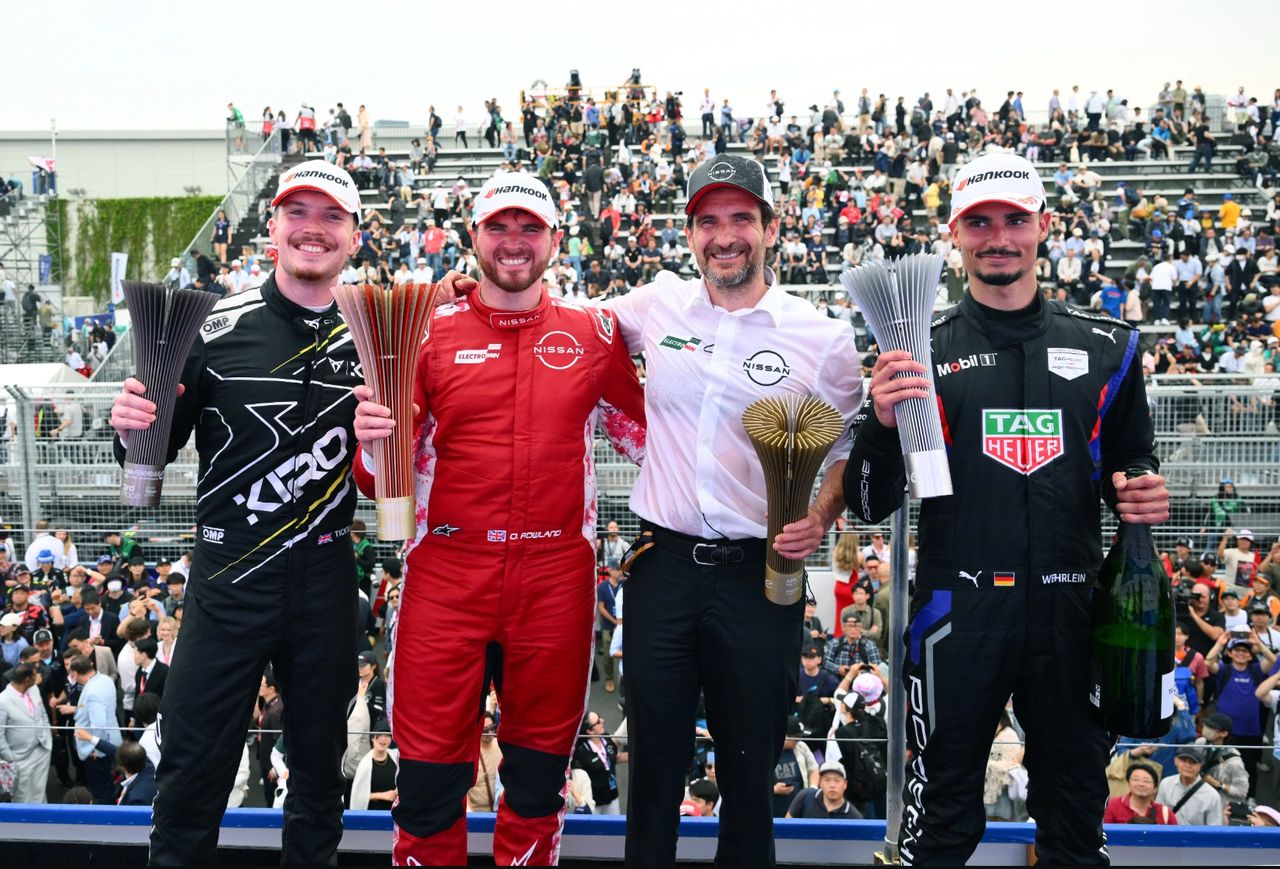
It was a race that felt more like a test — of nerve, of timing, of control. The kind that doesn’t rely on chaos to create drama, but on the choices drivers make when the race goes quiet. And in the stillness of a late Safety Car and a championship fight unfolding under grey Tokyo skies, Oliver Rowland got everything right.
This wasn’t the sort of race that grabs attention with wheel-banging heroics or last-lap lunges. It was measured, strategic — one for the thinkers. And Rowland, at the wheel of a Nissan on home soil, looked every bit the driver in control of his season, even when he briefly wasn’t in control of the race.
A Game of Margins
Rowland started from pole, a position that in Formula E rarely guarantees anything — especially on a day when ATTACK MODE activations and energy margins can undo even the best-prepared. For a moment, it looked like it had. He dropped to sixth during the latter stages of the race after activating his final ATTACK MODE later than those around him.
But Rowland didn’t panic. He executed.
Rejoining with the final seconds of his boost intact, he hunted. Pascal Wehrlein, the reigning champion and the de facto benchmark in Porsche machinery, was in the lead — but vulnerable. Between Turns 15 and 16, Rowland squeezed through with just enough left in reserve and just enough trust in the car beneath him. It was a pass that didn’t require brute force — only belief.
From there, it was never in doubt. A home win for Nissan. A fourth of the season for Rowland. And, significantly, the kind of performance that doesn’t just win races — it wins titles.
An Evolving Threat
There was a time when Rowland’s place in the championship narrative felt uncertain — strong pace, sure, but too often undone by the sport’s trademark volatility. But not anymore. Now, he’s the one setting the tone. And as the calendar tips into its second half, he’s beginning to make the extraordinary look routine.
161 points. A lead of 77 over Wehrlein. The largest mid-season advantage in Formula E history. For all its reputation for unpredictability, this season has started to take on a very familiar shape.
Quiet Performers, Loud Statements
Behind Rowland, Wehrlein’s second place felt both commendable and frustrating. The German drove a near-flawless race, but with no extra power to defend against Rowland’s final push, there was little he could do.
More telling, perhaps, was the performance of Dan Ticktum. After a turbulent season filled with flashes of promise but few results to match, the CUPRA Kiro driver finally stepped onto the Formula E podium. Third place came with a hint of what might have been — a better result was likely had the late Safety Car not neutralised his energy advantage. But on balance, it was a mature, composed drive. And a breakthrough.
Jake Dennis, starting 14th, slipped under the radar for much of the race, but a savvy use of energy and ATTACK MODE vaulted him to fourth. It was a typically efficient performance from the Andretti driver — one that speaks volumes even when it barely makes the highlights reel.
Further back, Lucas di Grassi delivered a quietly impressive drive to fifth for Lola Yamaha ABT — a result that offered promise for the still-young collaboration. Jean-Éric Vergne rounded out the top six, another consistent outing in a season where DS PENSKE have often lacked just that.
Beyond the Racing Line
As ever with Formula E, the Tokyo E-Prix wasn’t just about on-track competition. There were moments of pageantry and purpose woven through the weekend — from Sung Kang’s garage walkabouts to Faf de Klerk’s presence trackside. The fan village buzzed to the sounds of R&B artist SIRUP, and the paddock made room for real-world conversations on sustainability, inclusion, and community.
The “Change. Accelerated. Live” summit returned, bringing together voices from across motorsport, academia, and beyond — a reminder that Formula E continues to push not just performance, but progress.
Initiatives like FIA Girls on Track and the Better Futures Fund found their footing among the weekend’s celebrations. More than 2,000 local residents and students were brought into the paddock across race week, while €25,000 went to Tokyo’s social welfare programmes. The sport’s intent to leave something behind beyond skid marks is beginning to feel more like foundation than feature.
Where It Leads
The championship now shifts east once more, with a double-header in Shanghai closing out May. Rowland knows the job isn’t done, but if Tokyo proved anything, it’s that he no longer needs the conditions to be perfect to win. He just needs a plan.
For Nissan, it was a weekend of vindication. For Formula E, a reminder that even in the absence of chaos, motorsport can still be quietly, deeply compelling.
Up Next
Formula E heads to Shanghai for Rounds 10 and 11, 31 May & 1 June. With momentum on his side, Rowland’s rivals have work to do — and fast.