


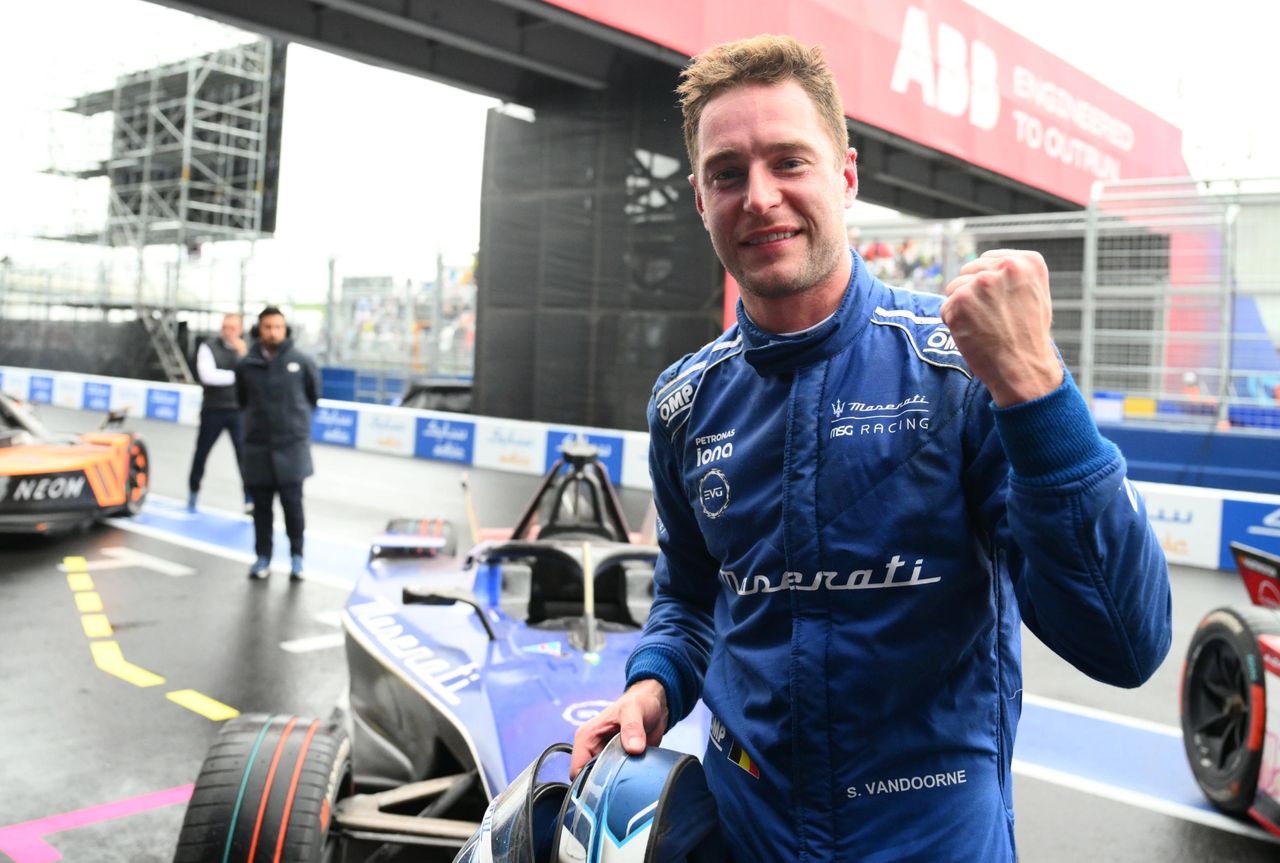
Tokyo, Japan – May 17, 2025
By the time the rain began to thin over the paddock at Big Sight, the course of Round 8 of the Formula E season had already shifted — not with fanfare or force, but with timing. Stoffel Vandoorne’s first win in nearly three years didn’t come from out-and-out pace, but from a quiet confidence in strategy, and a rare combination of patience and precision when the streets of Tokyo turned slick.
For Maserati MSG Racing, it was more than just another box ticked. This was a validation. Of approach, of execution, and of a driver who’s always made more sense over the long view than in the heat of short-term headlines.
A Calculated Early Burn
In a series where strategic innovation is often reactive, Maserati MSG Racing took the proactive route. The choice to burn energy early and trigger an early PIT BOOST stop — the championship’s evolving energy management twist — wasn’t necessarily flashy. But it was bold.
With usable energy deliberately front-loaded into the opening laps, the team banked on one of the oldest variables in motorsport: that in chaos, opportunity comes to those best prepared for it. The red flag, brought out when Maximilian Guenther’s car shut down in an awkward position, reset the race around a new context — one that left Vandoorne net leader and the rest of the field boxed in by convention.
What followed wasn’t dominant so much as it was disciplined. After the restart, Vandoorne never needed to pull away so much as maintain composure — managing the gap, conserving energy, and holding the rhythm through treacherous conditions.
“It was a very aggressive strategy,” Vandoorne admitted. “A bit of a gamble. But once the red flag came, I knew what we’d achieved — we just had to bring it home.”
Rowland’s Margin Grows, but So Do the Questions
Oliver Rowland’s second-place finish, on the surface, adds to an already commanding season. He now leads the Drivers’ standings by a record 60 points — a margin that invites conversation not just about how he’s driving, but how others are falling short.
This was a performance that, in most conditions, would have delivered a win. Rowland controlled the early phases from pole, with typical measured aggression. But unlike Monaco — where an early pitter stole the race from under him — Tokyo was simply a case of a different chess game unfolding while he played his.
“There’s maybe some tweaking to do on the way we manage pit stop strategy,” Rowland noted with calm pragmatism post-race. “But honestly, I can’t complain. The pace was there.”
Crucially, Nissan now lead both the Teams’ and Manufacturers’ standings. On home soil, that carries weight. There’s symmetry in that statistic, though Porsche — just five points behind — remain a persistent presence just off-camera.
Barnard’s Ascent Continues
Taylor Barnard’s third-place finish felt less like a breakthrough and more like a continuation of something quietly impressive. The 20-year-old NEOM McLaren driver has become a familiar figure near the front, his fourth podium of the season marked by a daring outside move at Turn 16 — the same corner where he hit the wall a day earlier in Free Practice.
There’s a sense that Barnard is not just learning on the job, but expanding the job description. In conditions that exposed the limitations of experience, he raced with maturity. “We didn’t expect to race at all,” he said, referring to the worsening weather. “So to be back on the podium was a surprise — but a nice one.”
Behind the front three, there were stories worth watching: Sébastien Buemi’s fourth place showing for Envision Racing was his most convincing performance of the year. Dan Ticktum delivered a season-best fifth for CUPRA KIRO, while Edo Mortara’s sixth for Mahindra underscored the team’s quiet upward curve.
A Race Beyond the Track
Formula E has long traded in experiences that extend past the stopwatch. Tokyo’s second E-Prix weekend leaned into that identity — from Change. Accelerated. Live thought-leadership forums to youth-focused community engagement through Inspiration Hour and FIA Girls on Track.
The celebrity circuit was present, but not overbearing: Fast and Furious star Sung Kang returned to Tokyo, not just to wave the chequered flag, but to speak with students about sustainable careers in motorsport. Vinnie Hacker and Jett Ashford added digital age relevance, while Japanese actor Hideo Ishiguro offered a bridge between local culture and international sport.
Even the race’s energy mix — largely powered by HVO fuel — played its part in crafting a version of motorsport that increasingly understands its place in a changing world.
Looking Ahead: No PIT BOOST, All Pressure
Round 9 comes quickly, with Sunday offering a clean slate — and no PIT BOOST. The field will return to a more conventional race format, where qualifying and Attack Mode placement will likely dictate outcomes. Expect a tighter pack and fewer windows for improvisation.
But in Formula E, where energy is managed as carefully as tyre strategy in F1, even a “standard” race format can unravel into something unexpected. Especially on a track that, when wet, has already shown it can upend even the most robust race plans.
And for Vandoorne, for whom success has never come in surplus, this win feels earned in the quietest, cleverest way.