


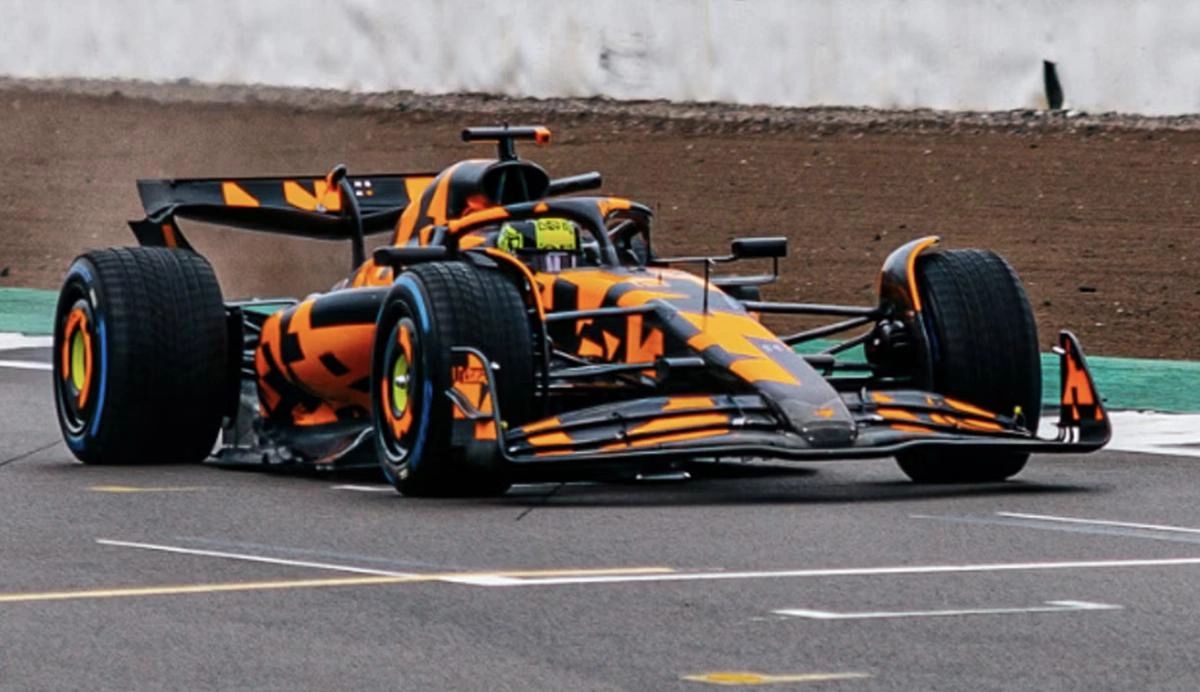
As Formula 1 enters a more tightly regulated aerodynamic era, the FIA’s new front-wing deflection tests have reshaped how teams approach compliance and Performance. The flexi-wing loophole — once a grey area exploited through clever material use and structural flex — has now been formally restricted. Yet, amid the noise and last-minute fixes from other teams, McLaren has emerged with a solution so subtle that it has been dubbed the “invisible” update.
They didn’t just react to the regulations — they anticipated them.
🔧 Regulation Tightens, McLaren Sharpens
Starting at the Spanish Grand Prix 🇪🇸, the FIA revised the front wing flexibility allowance, reducing the maximum permitted deflection from 15mm to 10mm under a 60N lateral load. That change aimed to clamp down on designs that flex under aerodynamic pressure, reducing drag on straights while maintaining downforce in corners — a well-known grey area in recent seasons.
Most teams were forced to introduce visible structural reinforcements or stiffen their wing geometry. McLaren, however, arrived in Barcelona with no declared update to the front wing — because they’d already tested and validated their revised solution at Imola 🇮🇹.
🔍 The Invisible Wing: What’s Changed?
On paper, McLaren’s front wing looks unchanged. But technical scrutiny reveals multiple fine-tuned differences:
- Upper Flap Tip Redesign: The outer edge of the flap, where it meets the endplate, has been shortened and squared off. Previously, it extended into a narrow point, which offered potential flex in load transitions. The revised geometry now finishes more abruptly — a subtle but deliberate choice to prevent twisting under load.
- Internal Flap Reprofiling: The camber of the flap and thickness of the flap itself has also been subtly modified. These refinements reduce torsional movement at speed while preserving aerodynamic consistency across various yaw angles.
- New Horseshoe Support: A small, stiffening bracket underneath the wing (horseshoe-shaped) has been added to prevent further lateral displacement — barely visible from above but crucial in reducing flex during high-speed cornering.
- Relocated Flap Adjuster: The flap adjuster mechanism has been slightly moved and reoriented. While that seems minor, it reduces leverage-induced deflection in load-critical areas.
The result is a structure that meets the new deflection tests — less than 10mm movement under 60N lateral force — while retaining the aerodynamic philosophy of the original design.
🧠 Tested Early, Deployed Seamlessly
While other teams scrambled to adjust after the FIA’s announcement, McLaren had already begun validating their solution during Friday practice at the Emilia Romagna Grand Prix. Lando Norris ran both old and new front wing specifications back-to-back in FP1 and FP2, giving engineers crucial real-world correlation data. They even went as far as installing their own monitoring on the MCL39 — a clear indication of how closely they were monitoring the wing’s live behaviour under load.
Curiously, no mention of the update appeared in the car presentation documents, something that has caused a stir online, not at Imola, and not in the two rounds that followed. For observers who rely on those declarations to track upgrades, it may have seemed like something was missing. But McLaren were fully within their rights to stay quiet. The FIA only requires teams to report modifications to major aerodynamic assemblies; this, by contrast, was a structural refinement, not a full redesign.
That proactive, methodical approach allowed them to:
✅ Validate CFD and wind tunnel results
✅ Maintain continuity with their aerodynamic upgrade path
✅ Enter Barcelona with zero compromise in setup
This quiet confidence — not needing to rush, not needing to announce — is perhaps the greatest testament to the strength of McLaren’s development model in 2025.
⚙️ Performance? Unaffected — and Unmatched
What’s most remarkable isn’t just the engineering subtlety but the Performance it has preserved. McLaren topped both Friday sessions in Spain, with Norris leading FP1 and Piastri heading FP2. The car’s balance in high-speed corners remained intact, the straight-line pace was untouched, and tyre degradation was impressively stable across longer runs.
This isn’t just a flexi-wing workaround. It’s a fully developed front-end evolution of their existing front wing that fits perfectly into McLaren’s trajectory this season — one built on methodical upgrades, not reactive fixes.
📐 Philosophy in the Details
What McLaren has done speaks volumes beyond carbon and camber. It reflects a culture of:
🔸 Predictive Engineering – solving problems before they arrive
🔸 Silent Efficiency – gaining Performance without chasing headlines
🔸 Championship Mentality – thinking long-term in a short-term sport
While other teams chase compliance at the expense of Performance, McLaren has integrated compliance into their Performance. And that makes all the difference.
🚀 Conclusion
The “invisible” front wing isn’t just a clever update — it’s a symbol of how far McLaren has come. No drama, no declarations, no dip in pace. It’s just the quiet evolution of a team that’s no longer catching up — but leading the way.
In the age of regulation-driven development, it’s not about how loudly you update; it’s about how effectively you update. It’s about how well you see what’s coming next. And right now, no one sees the road ahead clearer than McLaren. 🧡