


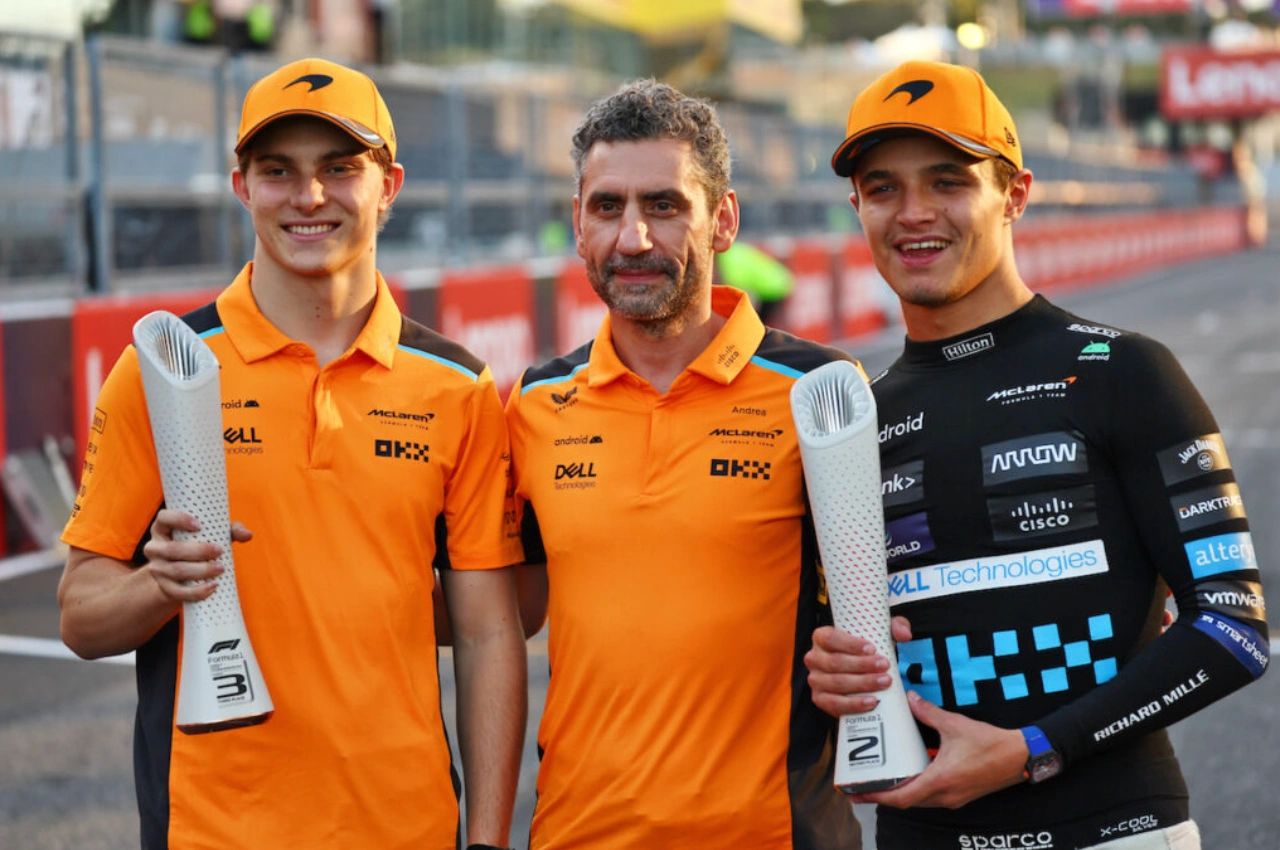
In modern Formula 1, the rarest balance is not technical harmony or straight-line speed. It’s human equilibrium. Two equally quick, hungry drivers and poised to lead — but only one championship. That’s not just a luxury. It’s a lit fuse.
McLaren knows it. They’ve been here before.
And at Imola, that fuse came into view.
A Sunday That Asked Quiet Questions
The Emilia-Romagna Grand Prix did not produce fireworks, at least not in the traditional sense. There were no crashes between teammates. No radio expletives. No need for debrief tension diffusers.
But what it did offer was something more instructive: a glimpse into McLaren’s internal structure under pressure.
When a late-race Safety Car reset the field, Lando Norris — running behind Max Verstappen — opted to pit. Oscar Piastri, a few seconds back, stayed out. In the shuffle, the Australian inherited track position. With Norris now on fresher tyres and faster, McLaren was faced with the kind of scenario every team fears: two evenly matched cars, running close, on differing strategies, a race win still within reach, but only if they made the right call and made it quick.
The call? Let them race.
And they did — just. It was measured. Surgical. Respectful. But if you listened closely, you could hear the rumble of something deeper.
“At some point, self-interest will always outweigh team interest,” Red Bull’s Christian Horner said post-race. “That’s the conflict.”
It sounded like a provocation, but it was closer to prophecy from a team principal who was celebrating 400 race starts with Red Bull and has seen it play out for himself. From Vettel and Webber to Ricciardo and Verstappen, Red Bull has had its share of intra-team turbulence—some productive, some pyrotechnic.
The Psychology of Parity
Piastri’s trajectory this season has been relentless. After a rookie year spent observing and a full year in 2024 under his belt, he’s stepped into 2025 with quiet defiance. He doesn’t overdrive. He doesn’t over-talk. But in every qualifying duel and every lap of clean air, he’s asking the same question: why shouldn’t I lead this team?
Norris, meanwhile, is no longer waiting for the moment. He wants to seize it. His 2025 campaign has moved from “potential” to “expectation.” He has the maturity of a leader and the memory of a driver who waited too long to win, and he understands his time has come.
For now, the relationship remains intact — two drivers raised in an era of media polish and mutual respect. But mutual respect doesn’t write strategy sheets. It doesn’t survive championship pressure unscathed. And most critically, it doesn’t answer the unspoken question: what happens when one starts to believe they’re being compromised?
The silence from the team during that final stint in Imola — no coded messages, no “hold position” instructions, no let the car most likely to win through — was both refreshing and ominous.
When Equal Means Unequal
The greatest myth in Formula 1 is that equal machinery creates equal opportunity. In reality, every race requires micro-prioritisation: pit windows, undercuts, the timing of upgrades, and even which side of the garage gets the final say in setup direction.
So far, McLaren has managed that balance well. But as both drivers pull themselves into the title frame, “balance” becomes more fragile.
Norris and Piastri are now in the hunt for the Drivers’ Championship, with Verstappen ready to pounce. McLaren sits top in the Constructors’ standings, a commanding lead over their rivals in a position of strength most teams want.
Let that sink in: this is no longer a team hoping to snatch a win on merit. This is a team with a credible shot at both titles, especially after clinching one last season.
But to do that, they’ll need to make choices. Real ones. Strategic ones. The kind that fractures relationships.
And that’s before the media asks Stella the inevitable, awaiting a different answer: just who’s your lead driver?
Technical Progress and Tactical Dilemmas
McLaren’s rise hasn’t just been driver-led. The technical department under Rob Marshall, Peter Prodromou and Neil Houldey has delivered tangible, measurable gains since last autumn. The MCL39 — a package looking so strong this season — features updates to last year’s car that generates more rear stability in high-speed direction changes, better tyre wear, allowing both drivers to attack apexes with greater confidence.
That stability has opened up a strategy range. But that same strength — consistent balance across setups — has compressed the difference between the drivers.
In previous seasons, you could tailor one car to suit the lead driver. Now, both cars are in the window. And that’s why McLaren’s garage, more than any other, may become the pressure point of 2025.
Because unlike Red Bull (where Verstappen is undisputed), or Mercedes (where hierarchy is soft but understood), McLaren has opted for genuine parity. No preference. No coded phrasing.
At least, not yet.
A Familiar Ghost in the Garage
The team’s most potent recent lesson in managing equal drivers is also its most painful. In 2007, McLaren entered the season with a generational rookie and a reigning double-world champion. They ended the year with zero titles and a schism that took a decade to repair.
The mistake wasn’t letting them race. The mistake was assuming they could race without intervention. That they wouldn’t eventually interpret silence as bias. That team unity could withstand personal ambition.
Stella knows this. He was in the paddock, albeit in another uniform.
But the 2025 context is different. Norris and Piastri aren’t at war. Yet. But neither are they drivers who will willingly play second fiddle — especially not when both have the car and the skill to win.
What Comes Next?
McLaren are entering the most critical phase of their modern resurgence. The car is competitive across circuit profiles. The reliability is holding. The drivers are maximising most weekends. The belief is tangible.
But belief alone doesn’t manage championship tension. That falls on Stella, on the strategists, on the unseen rhythms of internal debriefs and data sheets. It falls on the ability to act decisively before a rift becomes irreversible.
The next test will not come at a raw pace. It will come when one driver asks for a preferential strategy, when one driver gets the upgrade first or when one driver is told to hold position while the other takes the lead.
And when that moment arrives, it won’t be a question of talent or potential.
It will be a question of who McLaren believe in most — and how long they can afford to pretend the answer is still “both.”