

Mercedes have built what might be the best power unit on the 2026 grid. The problem is they are not the only ones who will use it. McLaren won the last two Constructors’ Championships with Mercedes power. Now the regulations reset completely and McLaren still have the same engine. Alpine and Williams get it too. Four teams with the same 350-kilowatt MGU-K, the same fuel from PETRONAS, the same thermal efficiency. Mercedes have released the technical specifications for the W17 E PERFORMANCE and the car looks strong. Whether the works team actually benefits from that strength is a different question entirely.
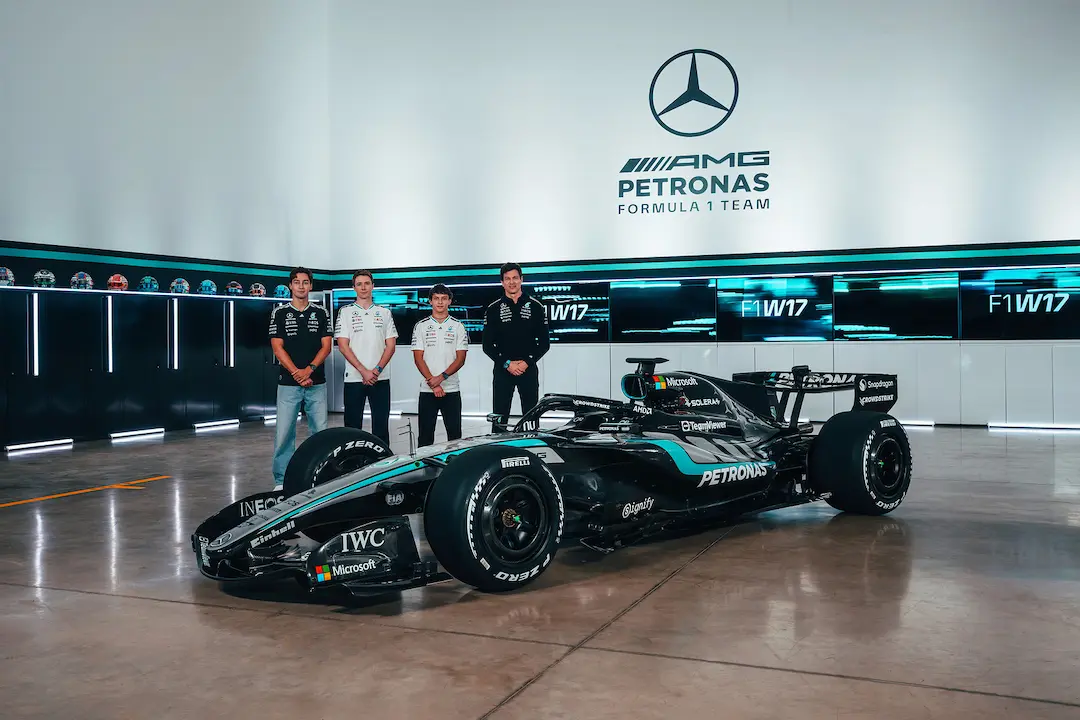
Key Points – Mercedes W17 2026
- Power unit split moves to near 50/50 between internal combustion and electric power (approximately 400kW ICE, 350kW electric)
- MGU-H removed, MGU-K power output increases from 120kW to 350kW
- Fuel flow reduced from 100kg per hour to approximately 75kg per hour
- Active aerodynamics replace DRS with moveable front and rear wings
- Cars 30kg lighter (770kg minimum including driver), 100mm narrower, 200mm shorter wheelbase
- Front tyres 25mm narrower, rear tyres 30mm narrower
- Advanced Sustainable Fuel delivers minimum 65% greenhouse gas savings
- Mercedes power unit supplies Alpine, McLaren, Williams, and the works team
- McLaren arrive as back-to-back Constructors’ Champions with the same Mercedes engine they used to win both titles
The MGU-H Safety Net Is Gone
The biggest change sits under the bodywork. Formula 1 power units used to run roughly 80 percent combustion, 20 percent electric. The W17 flips that. Near parity now. Around 400 kilowatts from the 1.6-litre V6. Around 350 kilowatts from the MGU-K.
That is not an adjustment. Complete rethink of how the car accelerates, brakes, manages energy.
The MGU-H is gone. That is the unit that harvested waste heat from exhaust gases. Complex. Expensive. Created a barrier for new manufacturers. Removing it opened the door for new teams but created a problem. How do you more than double electric power when you just removed one of the two recovery systems?
The answer is the MGU-K. It now produces 350 kilowatts. That was 120 before. Nearly three times the output. Mercedes did this without tripling the size and weight. Power density improved. The unit is more compact relative to what it delivers than anything seen in Formula 1 before.
“This challenge is reminiscent of 2014, when we began the first turbo-hybrid era and set a new standard in efficiency and readiness. Now, once again, we face a fresh mountain to climb.”
Hywel Thomas, Managing Director, Mercedes-AMG High Performance Powertrains
Fuel flow drops to approximately 75 kilograms per hour. Was 100 before. Less fuel means less energy from combustion. The electric side has to compensate. The engine has to be more thermally efficient. Every joule burned has to deliver more power. No choice.
This is where PETRONAS matters. Fuel formulation is not about marginal gains anymore. It is about making the system work at all. Advanced Sustainable Fuel has to deliver high energy density. Good volatility. High octane. Strict sustainability certification. The chemistry has to prevent deposits while releasing energy efficiently. All of it at once.
Mercedes claim their engines already exceed 50 percent thermal efficiency. That means more than half the fuel energy converts to usable power instead of heat. A modern road car sits around 30 to 35 percent. The regulations push that figure even higher.
In 2025, straight-line speed was mostly engine-driven. Fuel flow allowed it. In 2026 that changes. Less fuel means the engine cannot sustain the same push alone. Acceleration depends far more on electrical energy being available. When deployment is active, the car surges. When it runs out, acceleration tails off earlier. That matters deep into a stint when energy management becomes the difference between holding position and losing it. Drivers will feel this immediately.

Overtaking With DRS Gone
DRS is gone. Now it is active aerodynamics. Both front and rear wings have moveable flaps. The system works differently in two ways.
First, the wing flaps are available in designated zones regardless of gap to the car ahead. DRS required you to be within one second. Active aero can be used by anyone in specific track areas. Everyone gets the wings.
Second, OVERTAKE mode is separate from the wings. If you are within one second of the car ahead, you can recover and deploy additional electrical energy for a pass. The wings are available to everyone. The electrical boost is not. That is the difference.
Overtaking becomes less binary. DRS created a fixed advantage in one zone. You either got past or you did not. Active aero spreads opportunity across multiple zones. Lets the leading driver defend with the same tools. The edge comes from choosing when to deploy electrical energy, not just where. Drivers will feel that difference immediately.
Downforce and drag have both dropped compared to the ground-effect cars from 2022. Floors are simpler. Fewer Venturi tunnels. Less reliance on sealing to the track surface. The cars generate less grip from aero. That makes mechanical grip from tyres and suspension more important. It has to.
Mercedes went with push-rod front and rear suspension. Carbon-fibre wishbones. Push-rod sits the springs and dampers higher in the chassis than pull-rod. Typically means a slightly higher centre of gravity but better packaging around the gearbox and rear crash structure.
The choice between push-rod and pull-rod is not obvious. Red Bull ran pull-rod for years during their dominant run. Mercedes ran push-rod. Ferrari have switched between both. It comes down to where you package weight, how you manage geometry, what works with your aero philosophy.
By retaining dual push-rod, Mercedes are betting on mechanical familiarity over wholesale architecture change. They know what they have. They are sticking with it.
“Regulation changes are the lifeblood of Formula One innovation. They challenge every assumption, force us to think differently, and reward teamwork and ingenuity.”
James Allison, Technical Director, Mercedes-AMG PETRONAS F1 Team
Lighter Cars, Busier Drivers
The W17 is 30 kilograms lighter than the 2025 car. Minimum weight drops to 770 kilograms including the driver. Wheelbase is capped at 3,400 millimetres. That is 200 millimetres shorter. Overall width shrinks to 1,900 millimetres.
On paper those numbers sound modest. They are not. A shorter wheelbase makes the car more responsive on turn-in. It rotates faster into corners. The trade-off is reduced stability at high speed and less floor platform for downforce generation. You gain something. You lose something else.
Formula 1 cars have been gaining weight for years now and the FIA knew they had to go on a diet. Cutting 30 kilograms is just that. The basis is simple. A lighter car is a faster car. Lighter cars accelerate faster. Brake later. Change direction quicker. They are kinder to tyres too. Less mass means less energy hammering the rubber under braking and cornering. Tyre degradation should drop. That opens more strategic options. Teams will use that.
Tyres shrink as well. Front tyres lose 25 millimetres of width. Rears lose 30. Narrower tyres mean less contact patch. Less mechanical grip. Less drag. The 18-inch wheel diameter stays but construction changes to suit lighter cars.
Pirelli have not released full compound details yet. The direction is obvious though. Less downforce. Narrower tyres. Lighter cars. Mechanical grip matters again.
The cars will look more alive on screen. They react faster to steering. Rotate more eagerly. When the balance is right they look sharp. When it is not, mistakes show immediately. Slides happen earlier not later. Drivers have less margin but more feedback. This is why the car looks busy on television. It is.

Clean Fuel, Fewer Penalties
Formula 1 switches to Advanced Sustainable Fuel in 2026. This is not traditional biofuel. ASF comes from non-food biomass. Waste products. Renewable fuel created using captured carbon and renewable electricity.
The fuel must deliver at least 65 percent reduction in greenhouse gas emissions compared to fossil fuel. The entire supply chain is certified. All of it.
For performance, engines do not need redesign to run it. PETRONAS spent years developing fuel chemistry that balances sustainability with energy density, octane rating, combustion behaviour. Years of testing to get it right.
Energy density matters. If the fuel contains less energy per kilogram, power drops or fuel burns faster. With fuel flow capped at 75 kilograms per hour, efficiency is everything. There is no margin for error.
The fuel also has to prevent deposits inside the engine. Carbon build-up reduces efficiency. Causes failures. Detergent chemistry is as important as base fuel. Both have to work together.
Mercedes and PETRONAS tested the advanced fuel for over two years now. That early shakedown in Barcelona was the first crucial test for the team as it showed that the W17 can operate reliably with over 1100 laps completed by Mercedes power units even with Williams missing. That statistic should not be underestimated. When you throw so many changes into the pot all at the same time the first aim is simple. Does it run on track as you need it to. Now that box has been ticked the focus will be able to switch to performance.
Cleaner combustion means fewer reliability issues. Fewer forced power unit changes. That means fewer grid penalties. Sustainability matters and helps Formula 1 move towards its net zero target. So does finishing races with the same engine. Sustainable fuels developed by Aramco have been trialled in Formula 2 throughout the whole of last year which has given teams and engine manufacturers valuable data on how these fuels behave under race conditions.
“These rules will test every aspect of our organisation, while also creating significant opportunities to innovate and set new performance benchmarks.”
Toto Wolff, Team Principal and CEO, Mercedes-AMG PETRONAS F1 Team
Coffee Corner Take
Despite the very public show of congratulations, Mercedes will not be happy with the last set of regulations and the last two years. Winning races is the expectation. Powering someone else to back-to-back championships is not. Whilst good for business, it is not where the board or the team set their sights. McLaren took the 2024 and 2025 Constructors’ titles with Mercedes engines while the works team finished behind them. That is embarrassing for a team that spent eight seasons dominating the hybrid era.
They know the importance of getting 2026 right from the start. The last set of regulations proved that get a concept wrong and with the constraints of the cost cap you are in a world of pain. The Barcelona shakedown went well. Reliability looks solid. The car ran without major problems which suggests integration between power unit, chassis, and fuel is ahead of where it might be elsewhere.
There are those whispers that Mercedes locked in an advantage with the engine compression loophole. Just how big an advantage remains to be seen. The team insist their engine is legal, with Toto being very adamant that it passed every test and if there is an advantage then it is up to rivals to catch up, not for the FIA to introduce new tests to pin them back. A thought process that will no doubt be shared by the customer teams. If this advantage is true, the power unit might be the benchmark for not just the season but the other stages of the regulations. With a huge focus on what the power unit can deliver, this might just be the silver bullet to nailing these regulations.
But the team from Brackley also know that with confidence can come misguided arrogance, and it has killed them before. The 2022 regulation reset caught Mercedes flat-footed because they assumed their understanding of the previous rules would carry forward. They presumed their innovative zero sidepods would nail the advantage. It did not. They spent two years clawing back ground while Red Bull dominated. They cannot afford that again. If that happens again, suddenly the questions on Toto’s leadership will become more sharpened.
The issue Mercedes have is the same one they had in 2024 and 2025. Alpine, McLaren, and Williams all get the same Mercedes power unit. Same MGU-K output. Same fuel. Same thermal efficiency. If the engine is as strong as it looks, four teams benefit from it.
Gone are the days when a works team had the best power unit and gave their customers older models and late mapping for performance. The new F1 world does not do that. It levels the field. Whilst there is an advantage to being able to integrate your engine seamlessly into the chassis, the works engine advantage is not what it once was.
McLaren arrive in the new regulations as back-to-back Constructors’ Champions. They proved twice that they can build a better chassis around the Mercedes engine than Mercedes can. Where Mercedes struggled for cooling, McLaren found a way to get around that. Those things will not have gone unnoticed in Brixworth and Brackley at the Mercedes bases. If they get the 2026 chassis right again, Mercedes will be powering a third straight championship for someone else.
Alpine have given up their own works supply for this engine in the hope it powers them up the grid. Williams have been rebuilding and banking it all on the reset. Any of them could turn up with a car that uses the Mercedes engine better than the works team does. That is the big unknown here.
Mercedes have the engine. They have the reliability. They may even have an advantage baked in from the compression loophole that some rivals are still whispering about. But the risk of being an engine supplier in a regulation reset is that you can do everything right and still hand the trophy to your customer. McLaren have already shown they can win championships with Mercedes power, and if the W17 proves difficult to extract consistently, history suggests they will not hesitate to capitalise.
Join the Coffee Corner Motorsport Community
Dive into full race reports, data stories, and behind-the-scenes features
across Formula 1, Formula 2, and beyond.