


If you rewind two seasons, McLaren weren’t anywhere near the fight at the front. Oscar Piastri didn’t even see the flag on his first weekend. His debut ended with the car parked in the garage. And in the other car, Lando Norris had to pit six times in Bahrain just to drag it to the finish. When the dust settled, they were ninth in the standings. Not climbing. Just clinging on.
Fast forward to August 2025 and you’re looking at the team leading the Constructors’ Championship on 559 points. Reigning Constructor Champions and more than double Ferrari’s total. Both drivers in the thick of the title battle. And none of it came from a single lucky break.
The day-to-day culture shift
It started when Andrea Stella moved into the Team Principal role and Zak Brown stayed on as CEO. The car still needed work, but the bigger job was sorting out the way the team operated. The old setup was cautious, reactive, always on the back foot. Stella and Brown tore that out. Mistakes stopped being something to hide. They became problems to be pulled apart, understood, and fixed before they could happen again.
COO Piers Thynne calls it a shift from “good to extremely positive.” His version of positive isn’t posters on the wall. It’s engineers feeling free to speak up. “When things go wrong, whack-a-mole is not okay,” he says. “You involve people in fixing it so it doesn’t happen again.” And that’s not just management talk. Norris and Piastri don’t vanish between races. They sit with the simulator crews, the composites shop, even the design office. It’s not one-way traffic from track to factory. It goes both ways.
Zak’s big-picture plan
While Stella was doing that, Brown kept his head in the long-term game. He was the one signing off the £135 million wind tunnel. He green-lit simulator upgrades. He brought in key hires. And when results didn’t come immediately, he didn’t panic. “If you get the culture right, performance follows,” he says. Inside the team, they’ve even given it a name. The Zak Factor. It’s trust, it’s direction, it’s belief.
Breaking up the tech department
One of Stella’s biggest early calls was breaking up the Technical Director role. James Key left, and instead of replacing him with another single voice, the job was split in three. Peter Prodromou took aerodynamics. Neil Houldey took engineering. And Rob Marshall, fresh from Red Bull in 2024, took over as Chief Designer. Marshall brought a way of thinking McLaren hadn’t fully tapped before. Compact packaging, stable rear geometry, and aero built from the floor up. The difference showed in the MCL38 and MCL39. More stable. More predictable. And crucially, quicker to develop.
The Miami turning point
For most of 2023, upgrades came in small doses. Enough to move forward, never enough to leap. By mid-2024, that changed. Bigger, fully integrated packages replaced the constant trickle. Miami was the proof. A combined aero and suspension change gave them a wider setup window, better tyre life, and a calmer car on corner entry. From there, the results followed. Hungary brought a one-two. Zandvoort saw Norris master mixed conditions. Baku gave Piastri his first street win.
Finally, their own wind tunnel
Up until then, every wind tunnel run meant sending models to Toyota’s facility in Cologne. That’s 380 miles from the McLaren Technology Centre. The travel alone built delays into every concept. When the new tunnel at MTC came online, those delays disappeared. Scale models ran at real-world speeds metres from the design office. Data came back before the coffee cooled. Updates went from concept to track faster, and dead ends were caught earlier.
Cost cap and getting sharper under it
The £104 million cost cap hasn’t slowed them down. If anything, it’s made them sharper. No warehouse full of unused parts. Freight trimmed to essentials. Upgrades arriving at the point of maximum impact. “It’s a reset,” Thynne says. “If you get it right, it can define your next era.”
Two drivers pulling together
In the garage, the balance is clear. Norris is on 284 points, Piastri on 275. No number one. No number two. Fridays are often split. One driver runs one setup, the other tries something different. Then the feedback gets pooled. It’s the kind of cooperation most teams talk about, but few manage when the points gap is that tight.
Results that tell the story
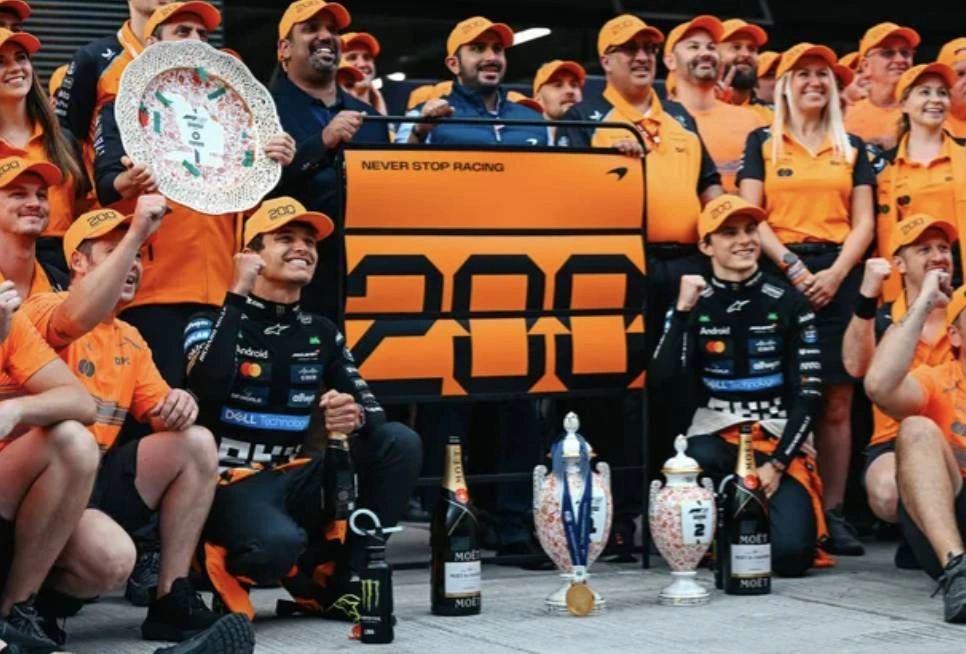
Australia: pole and win for Norris. Monaco: Norris again, Piastri third. Silverstone: a one-two in front of the home crowd, timed perfectly with a major upgrade. Hungary: McLaren’s 200th win, wrapped up with a strategy call that paid off.
From rebuilding to being the reference
Go back to 2017 and they were still rebuilding from scratch. In 2023, they were taking the hits and learning from them. 2024 was the leap. Now, in 2025, they’ve become the reference point for everyone else. This hasn’t been about luck, timing, or stumbling on a fast car. It’s five years of deliberate change, joined-up thinking, and trusting the process. McLaren haven’t just come back to the front. They’ve shown how to stay there.