


Confused by inconsistent penalties? Ever yelled “how is that not a penalty?” at your TV? You’re not alone – and now, finally, there are answers.
In a landmark moment for F1 transparency, the FIA has released the two documents that race stewards use every single Grand Prix weekend: the official Penalty Guidelines and Driving Standards Guidelines.
For the first time, fans can go beyond speculation and see exactly how decisions are made. This is the rulebook behind the rulebook – and it changes everything.
The Stewards’ Handbook: Now Public
Until now, we were often in the dark about the logic behind penalties. But the newly published documents being made public shed some light on this. The 2 Documents are –
- FIA Penalty Guidelines (v1.0, 14 May 2025)
- F1 Driving Standards Guidelines (v4.1, 20 February 2025)
These are designed to standardise how stewards interpret the Sporting Code. They aren’t official regulations, but they are the working reference used week in, week out.
Penalty Points: The System Behind Suspensions
Think 12 points means a race ban? You’re right – but here’s how the maths actually works:
Super Licence points system:
- Points come only with serious penalties (not reprimands or fines).
- They stay on a driver’s licence for 12 months.
- 12 points = automatic one-race ban.

Offences and Penalties – What’s Worth What?
This is where it gets juicy. The Penalty Guidelines list over 100 common infractions, each with a standard penalty and recommended point value.
Here’s a snapshot of what’s now out in the open:
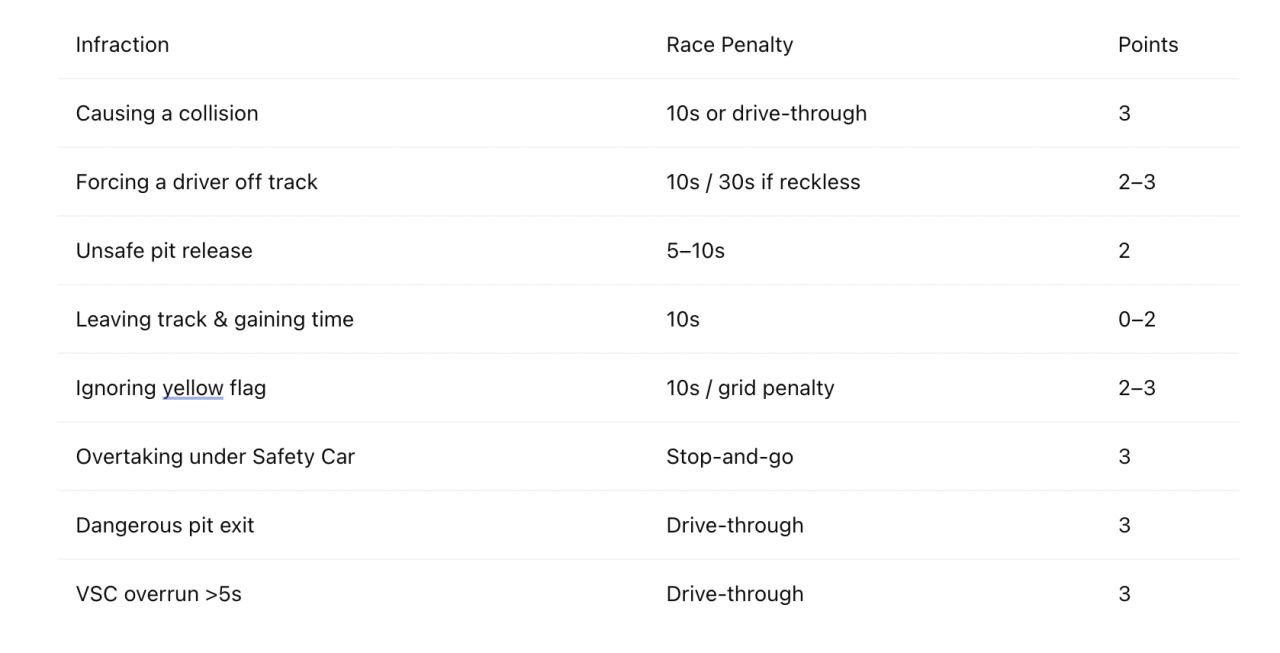
No more guesswork – we now know the benchmark penalties.
Driving Standards: What’s Legal – and What’s Not?
Before we dive in, it’s important to remember: these aren’t official rules. They’re guidance documents — created with input from drivers, teams, and the FIA to help stewards apply the Sporting Code consistently.
They don’t override the regulations. But in most cases, they define the expectations in wheel-to-wheel combat. This is what stewards look at when judging on-track behaviour.
Think you know the rules of engagement? These guidelines spell them out.
Inside Overtake
- Must be at least mirror-to-mirror by apex.
- No divebombs.
- Must follow a racing line and leave space.
Outside Overtake
- You must be fully ahead at apex to claim the corner.
- Exit space only required if attacker is ahead.
- Must stay on track unless forced off.
Unsafe Rejoins
- Can’t force others to lift, swerve, or brake.
- No full-speed rejoining from run-off.
Defending & Braking
- One move allowed.
- No changes after braking begins.
- Must leave a car width if returning to racing line.
This is as close as we’ve come to a universal code for wheel-to-wheel racing.
Track Limits – Now Fully Defined
Three strikes and you’re warned. Four or more, and the penalties begin:
- 3 strikes = black & white flag
- 4th = 5s penalty
- Each further = another 5s
But stewards can show leniency if:
- The driver lost control.
- They avoided a crash.
- They were forced wide.
Safety Car & VSC – Rules You Can See Coming
Forget mystery penalties under Safety Car or VSC.
This is how it breaks down:
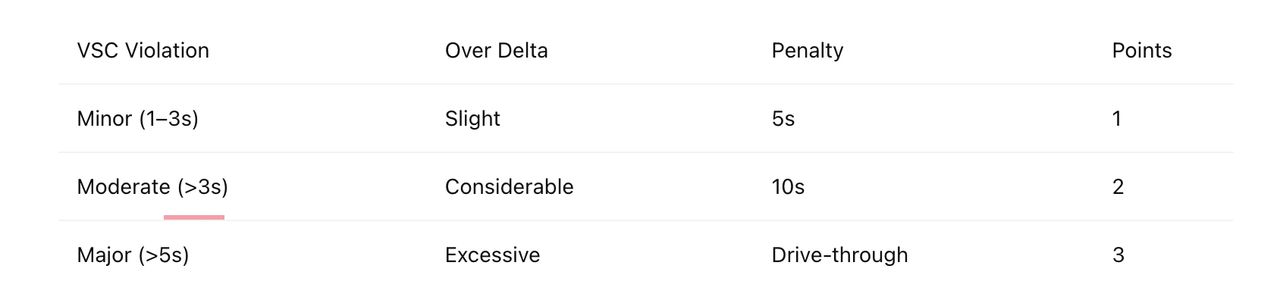
Under the Safety Car:
- Gaps must stay under 10 car lengths.
- The lead driver mustn’t brake unpredictably.
- No overtakes before green flag.
Are These Legally Binding? Or Just Guidelines?
No – and that’s a crucial point. These are not law. They’re internal references, written to support decision-making, not to override regulations. In most cases, decisions follow them closely – but stewards still have discretion.
So while the final call rests with the Stewards Panel, these documents form the invisible backbone of most rulings.
What Happens Next?
The FIA plans to roll out equivalent documents across:
- Formula 2
- Formula 3
- WRC
- WEC
- Junior categories
For the first time in modern F1, fans have a rulebook – not hidden behind the paddock gates, but right in front of them.
Sources
Appendix L – Code of Driving Conduct
FIA Formula 1 Penalty Guidelines (v1.0 – 14 May 2025)
F1 Driving Standards Guidelines (v4.1 – 20 February 2025)
FIA International Sporting Code (2025)