


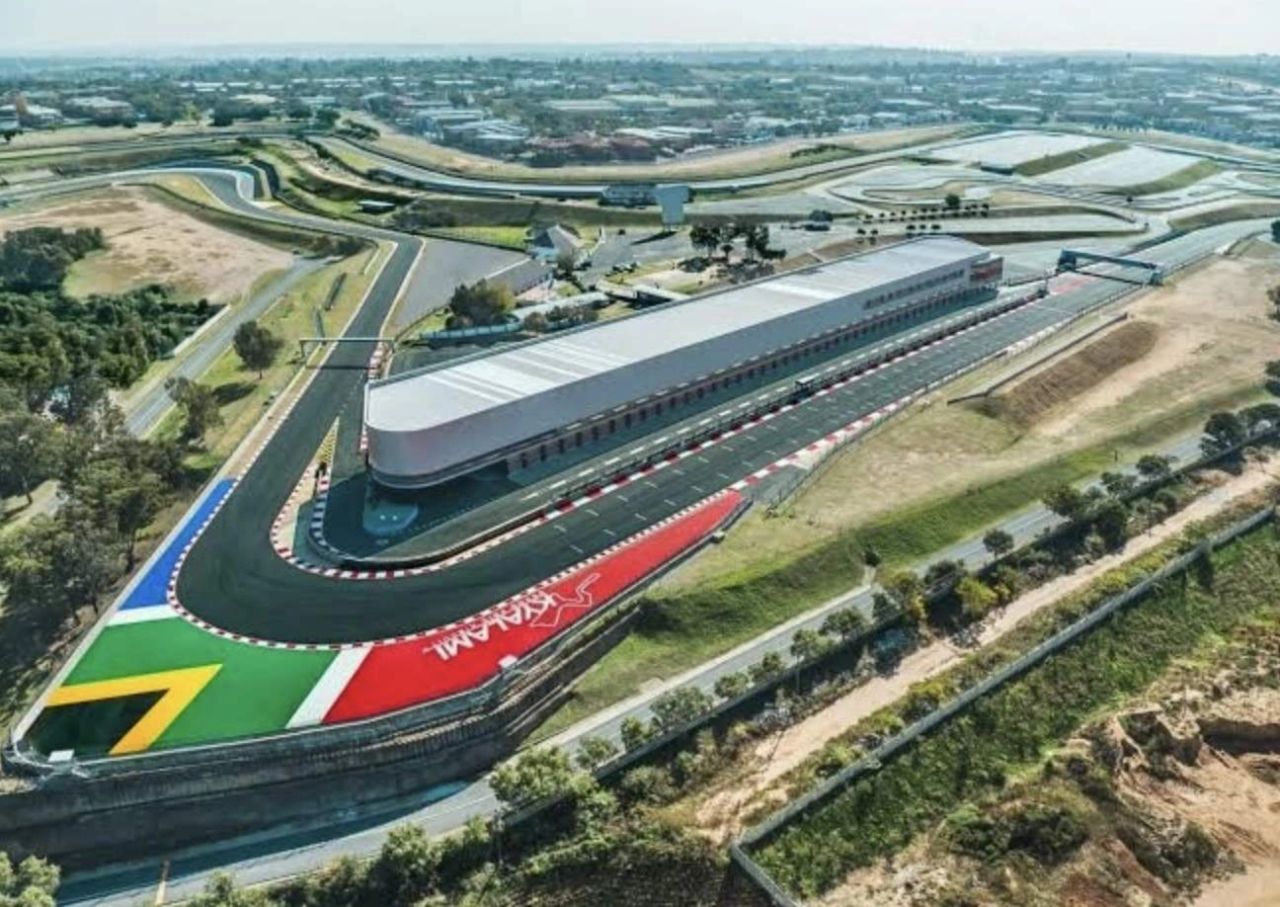
After years of quiet ambition, South Africa’s Kyalami circuit has taken a real step toward regaining Formula 1 status. The FIA has approved detailed upgrade proposals that would allow the venue to meet the safety and infrastructure demands required to rejoin the world championship, but only if the sport makes space on its already crowded calendar.
The approval removes a long-standing obstacle: Kyalami’s current FIA rating. At present, it holds a Grade 2 license, enough for categories like GT3 and endurance racing, but not for Formula 1. The revised plan, developed with UK-based Apex Circuit Design, outlines enhancements needed to achieve the coveted Grade 1 classification. These plans do not initiate construction immediately; instead, they serve as a green light to begin if and only if South Africa secures a slot on the official F1 calendar.
Kyalami, a high-speed circuit on the outskirts of Johannesburg, hasn’t hosted a Grand Prix since 1993, the last time Formula 1 touched down on African soil. Since then, the track has undergone major renovations, most notably in 2015, when it was modernised with a reshaped pit lane, new paddock infrastructure, and improved track surfaces. Today’s approval represents a new phase in that evolution, focused not on appearance but on compliance.
The newly approved upgrades won’t touch the layout itself. Instead, changes will focus on support systems: expanded run-off areas to increase safety margins, reprofiled kerbs to match current F1 cars’ ride characteristics, FIA-standard TecPro barrier installations, improved debris fencing, and overhauled drainage systems to meet wet-weather racing protocols. These are not cosmetic tweaks. They’re foundational adjustments designed to bring Kyalami up to the same standard as modern tracks in Saudi Arabia, Azerbaijan, and Miami.
Toby Venter, who purchased the circuit over a decade ago, called the development a milestone in its modern revival. “We always saw Kyalami as a future hub for top-tier motorsport. This approval marks a turning point we’re closer than ever to seeing F1 back on African tarmac.”
Venter’s investment group acquired Kyalami in 2014 when the circuit was under threat of closure. Since then, the team has hosted GT3 championships, local touring car series, historical events, and multiple manufacturer test days, but F1 has remained the ultimate ambition. This announcement brings that ambition significantly closer.
A Continent Competes
The challenge, however, is not technical. It’s strategic. Formula 1 CEO Stefano Domenicali confirmed last month that the sport remains in talks with three potential hosts across Africa: Kyalami, a proposed Cape Town street race, and a new circuit outside Kigali in Rwanda.
Of the three, Kyalami is the only one with an operational track and now crucially a greenlighted plan to meet all FIA technical criteria. Cape Town’s concept is still in early development, while the Kigali project has been overshadowed by regional instability and diplomatic pressure. That Rwandan bid, presented during the FIA’s annual prize-giving gala in Kigali last December, was seen as a symbolic gesture of support from the FIA. However, a conflict involving M23 rebels in the eastern Congo has since drawn criticism and diplomatic caution, including formal requests from the DRC for F1 to suspend its talks with Rwanda.
Kyalami’s advantage isn’t just about readiness. It’s also about history. The track hosted 20 South African Grands Prix between 1967 and 1993, won by the likes of Niki Lauda, Alain Prost, and Ayrton Senna. It’s part of F1’s heritage — a legacy the sport increasingly leans on amid rapid global expansion.
That may strengthen Kyalami’s position, but nothing is guaranteed. As Domenicali said at the Monaco Grand Prix, “We are missing one continent, and we want to connect also to that. It’s a matter of finding the right plan.”
With Thailand recently announcing a $1.23 billion deal to build a Bangkok street race and Montreal locking in a contract extension through 2035, the window for new additions is narrowing. Any new entrant must prove not just technical compliance but also financial readiness and political support. Sources close to the F1 calendar negotiations suggest that an African race could materialise in either 2027 or 2028 if another event is dropped or rotated, but only if contractual obligations, freight logistics, and promoter backing are aligned.
Still Waiting for the Call
The significance of the FIA’s approval is hard to overstate. It eliminates the easiest reason for F1 to say no. For years, officials could cite infrastructure limitations or homologation issues. Now, the track is essentially ready and only waiting on the go-ahead.
Support for a South African Grand Prix has been growing inside the paddock. Lewis Hamilton has long been an outspoken advocate for the continent’s return to the calendar, arguing it’s essential for F1 to reflect true global reach. “It would be a truly special moment for me personally and for millions of fans across Africa,” he said during negotiations in 2022.
The pressure isn’t just cultural. It’s commercial. Brands, broadcasters, and African motorsport federations see an untapped market with both grassroots interest and elite infrastructure potential. Kyalami sits just minutes from Johannesburg’s financial district, has access to international airports and top-tier hotels, and is already integrated into manufacturer test calendars.
Whether that happens remains to be seen. But for the first time in a generation, South Africa has a venue equipped, approved, and politically stable enough to make Formula 1’s long-awaited African return a reality.