


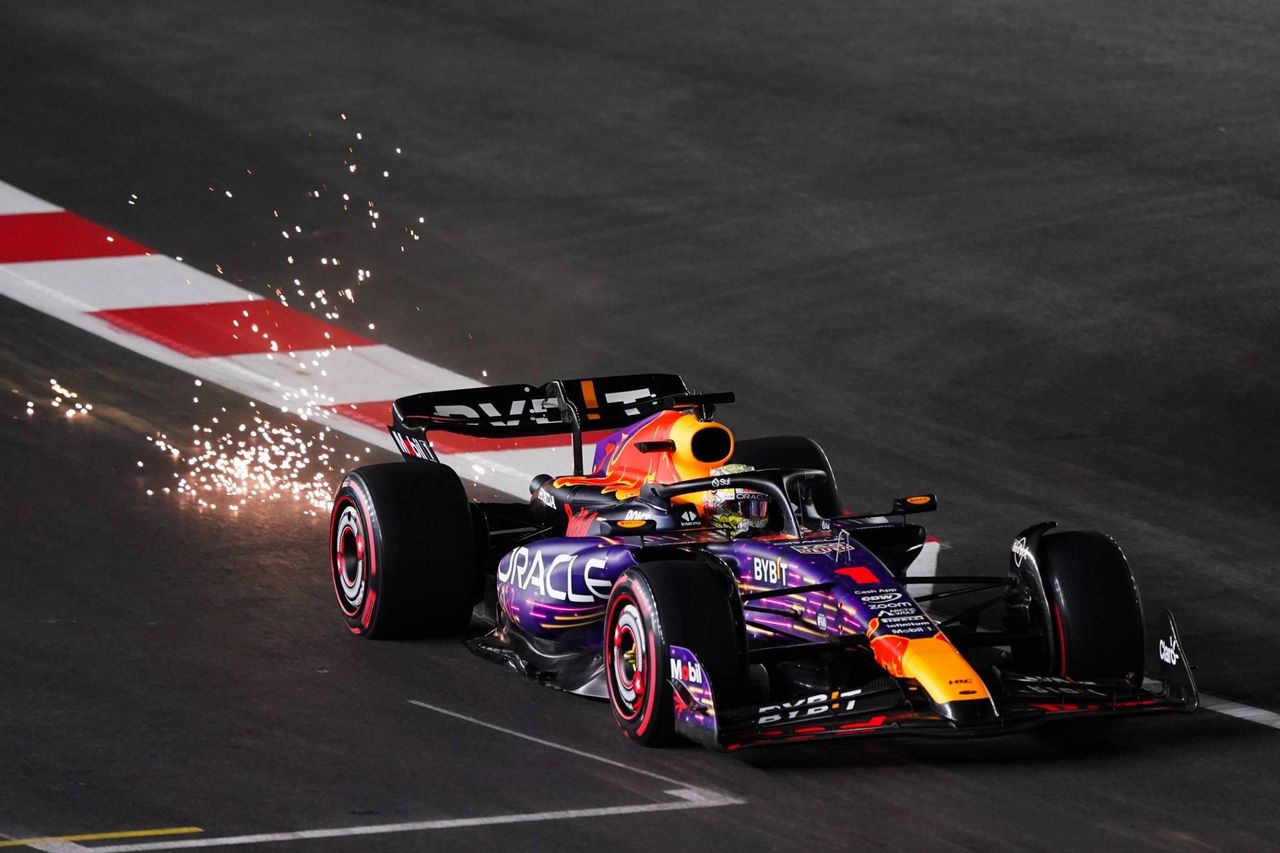
Not every F1 experiment makes it into the rulebook. Some barely make it past Friday.
That was the case in Barcelona, where the FIA quietly trialled steel skid blocks on a few cars during free practice. It wasn’t part of any public directive, and it didn’t get much paddock attention. But behind the scenes, it was a serious look at whether Formula 1 needed to rethink what’s sparking underneath its cars.
The test came after a few small grass fires broke out at recent races — mainly Suzuka and Shanghai. It raised a question: could the titanium skid blocks, which throw off sparks as they grind into the asphalt, be the cause?
These blocks are part of the plank — the flat wooden floor that runs beneath every F1 car. They’re there to monitor wear and enforce ride height. If your car rides too low and scrapes too much plank away, you get disqualified. But those titanium blocks? They burn hot. Sparks can hit over 1600°C. If a car runs wide and kicks that heat into dry grass… you see where this is going.
So the FIA asked teams to run steel versions for comparison. Fewer sparks, lower heat, safer outcome — in theory.
The reality? It didn’t go down well.
Steel wore faster. Teams didn’t like how it handled kerbs, or how it affected balance on longer stints. And because the material is heavier, it slightly altered weight distribution and ride dynamics — not ideal when setup margins are already razor-thin.
More than anything, there was concern about consistency. The steel blocks degraded unevenly. And in F1, if your plank wears too far in one spot, even by a millimetre, you’re out. No grey area. Just a black-and-white DQ. So the teams were wary.
After the test, the FIA issued a formal update:
“Following analysis of the stainless steel skid block trials in Barcelona, the FIA has revised the implementation plan outlined in TD015.
Titanium skid blocks will remain the mandated material for the remainder of the season.
However, teams are requested to have stainless steel skid blocks available at all events, as they may become mandatory if similar grass fire incidents occur as seen in Suzuka early this year.
Additional testing of stainless steel skid blocks will be conducted at selected events throughout the season to support further evaluation.”
So — titanium stays. But the FIA’s not walking away entirely.
Teams must now keep homologated steel blocks ready at every round. That means the option is live — and could be called into play at short notice if conditions demand it.
This is how the FIA often handles safety evolution: no mid-season bans, no hard resets, just quiet control. Small tests, localised adjustments, and tools in place before anyone realises they’re needed.
So yes — the sparks are staying. But the solution, if the grass flares up again, is already packed and ready in every team’s freight.