


Pirelli Preview – Coffee Corner Motorsport
It’s the last race before the summer break. Temperatures are climbing. And Hungary is set to hit 40 in more ways than one.
Formula 1 returns to the Hungaroring this weekend for the 40th running of the Hungarian Grand Prix. But it’s not just the race that matters. Pirelli will be staying on after the chequered flag for a two-day tyre test that could shape the direction of 2026. Ferrari, Racing Bulls, McLaren and Alpine are all taking part, with prototype compounds and new constructions under review with the next homologation deadline just around the corner.
It’s a big weekend. On track. And behind the scenes.
A Classic Track With New Asphalt
Hungary’s been a mainstay on the F1 calendar since 1986, and even through the COVID season of 2020 it never dropped off. This year marks its 40th anniversary and the circuit has had a facelift.
The pit lane and main straight have been fully resurfaced using 860 tonnes of custom bitumen, designed to stay firm even in high temperatures. It’s already been run in during GT events earlier this month, but the real test will come this weekend as 20 F1 cars scrub it in under full load.
The pit complex and main grandstand have also been upgraded as part of the circuit’s long-term redevelopment plan. It’s still the tight, technical Hungaroring we know. But hopefully a bit smoother.
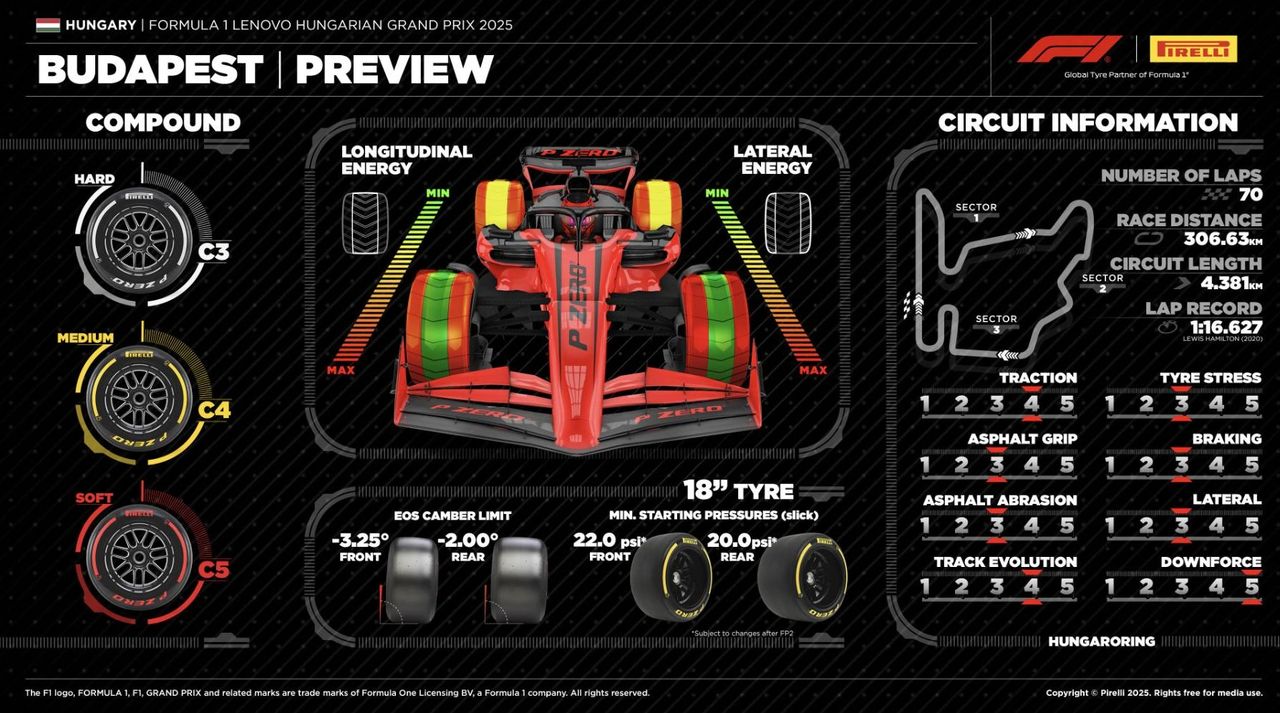
Compound Choices: Same as 2024
Pirelli’s bringing the same tyres as last year. That means:
- C3 for Hard
- C4 for Medium
- C5 for Soft
The C6 is now part of the range in 2025, but Hungary’s layout and surface make it too soft for this event. Despite the relatively low peak loads, the short lap means tyres never really get a breather. Add high ambient temperatures and thermal degradation becomes the limiting factor.
Last year’s race saw the highest recorded track temperature of the season at 58.6°C. While we’re not expecting quite those extremes, the forecasted sunshine and warm ambient temperatures could still make tyre management a key factor on Sunday.
Strategy in 2024: Mostly Two-Stops
Most of the grid went for two stops last year. Mediums were the go-to, with 13 drivers starting on the C4. Four others went with the Soft, and three chose Hards.
Tsunoda was the only driver to make a one-stop work, while some ran a short third stint on the Soft at the end. Aston Martin split their strategy completely, using all three compounds across both cars. Stroll even managed the longest Soft stint of the race at 14 laps.
Expect more of the same this time, especially with the high track evolution across the weekend. Friday’s long runs will likely show graining on the fronts early on, but that should clean up by Saturday as rubber goes down.
Track Evolution and Qualifying Pressure
The Hungaroring is notorious for evolving quickly, especially through Friday and Saturday. A dusty start, a sharp increase in grip, and a track that can punish anyone who gets caught on the wrong setup window.
The new asphalt could help with consistency, but it won’t stop overheating. The final sector in particular is brutal on the rear tyres. Qualifying on the Soft might look fast for one lap, but overdriving the middle sector could easily kill the final two corners if tyre temps get out of hand.
Tyre Testing After the Race
On Tuesday and Wednesday after the Grand Prix, Pirelli will stay at the Hungaroring for a critical 2026 tyre development test.
The construction for next season must be locked in by 1 September. The compounds get finalised by 15 December. So this test matters.
Teams running:
- Ferrari
- McLaren
- Racing Bulls (one day)
- Alpine (both days)
The test will focus on next-gen structures and some prototype compounds. It’s one of the last in-season tests left this year, with only six more days of running planned across Monza, Mugello and Mexico City.
Behind the Numbers: Pressure and Prep
Before any of that happens, Pirelli’s tyre fitting team will go through their usual prep. Each tyre gets dried air pumped in at 60 psi to seat it properly, then dropped to 45 psi before teams take over. From there, teams can choose to switch to nitrogen, but not any other gas mix.
Initial pressure targets for Hungary are:
- Fronts: 22 psi
- Rears: 20 psi
As always, these can be adjusted session by session if safety conditions require.
Records and Stats at the Hungaroring
- Most wins (driver): Lewis Hamilton, 8
- Most podiums (driver): Hamilton again, with 12
- Most team wins: McLaren, 12
- Ferrari has the most podiums overall with 29
It’s also the place where three current drivers scored their first F1 victories:
- Fernando Alonso (2003)
- Esteban Ocon (2021)
- Oscar Piastri (2024)
Final Word
This is one of the shortest tracks on the calendar, but Hungary never lacks for drama. If the heat plays its part and the grip doesn’t come quickly, qualifying could be a mess. And race day will be all about keeping the tyres in shape.
One more chance to get it right before F1 heads into the break.