


The FIA stewards have overturned Carlos Sainz’s Dutch Grand Prix penalty after a Right of Review under Article 14 of the International Sporting Code, reclassifying his Zandvoort clash with Liam Lawson as a racing incident.
New 360° onboard from Sainz and Lawson’s rear facing camera, unavailable during the race, met the “new, significant and relevant” evidence test. Williams thanked the panel after submitting the petition that triggered the review.
Key points
- Article 14 Right of Review granted on new onboard footage
- Evidence must be new, significant, relevant, and unavailable at the time
- Verdict: racing incident, neither driver wholly or predominantly to blame
- Zandvoort result stands; Sainz’s two licence penalty points removed
- Williams thanked the stewards for reconsidering
- Signals how 2025 Driving Standards Guidelines are being applied
The original penalty at Zandvoort
The Dutch GP was already messy when Sainz and Lawson came together at Turn 1 after the restart.
The Stewards judged Sainz guilty. A ten second time penalty in the race. Two points slapped onto his licence. End of story, it seemed.
Williams thought otherwise. They believed Lawson’s car snapped mid corner, not Sainz lunging recklessly. Days later they pulled Article 14 off the shelf and asked for a Right of Review.
The ten second time penalty and two licence points were applied during the 2025 Dutch Grand Prix at Zandvoort under the FIA International Sporting Code.
How the FIA Right of Review works (Article 14)
Getting a call overturned in Formula 1? Almost impossible.
The rule says a team has to show the Stewards something they never had. It must be new. It must be relevant. It must be significant. And it cannot have been available at the time of the original decision.
Most attempts die right there. Williams thought they had enough to clear it. Their case rested on three pieces: Sainz’s 360 view, Lawson’s rear camera, and Sainz’s own word.
Inside the hearings
The first hearing happened on 12 September. Video call, with all the big players dialled in. Williams sporting director Sven Smeets. Team manager Dave Redding. Sainz himself.
Across the table, Lawson and VCARB manager Marco Perrone. FIA sporting director Tim Malyon.
When the review was allowed to move forward, McLaren and Aston Martin were even invited to observe. Everyone in the pit lane was watching.
What the footage revealed
The Lawson rear cam was the turning point.
It showed his car stepping left mid corner post restart on cold tyres. Just a snap. Enough to clip Sainz’s front right and cause the contact.
Williams argued that changed the picture. Sainz admitted he had taken a risk around the outside and did not have the right to space under the rules. But he also said he had left room and was prepared to back out on the exit. What caught him was Lawson’s snap.
Lawson disagreed. He told the Stewards these movements are normal when you are pushing wheel to wheel on fresh tyres.
The stewards’ final call
After weighing the new footage and the testimony, the panel rescinded the penalty.
Lawson’s snap was the cause. But Sainz was not blameless either. By putting his car on the outside with no right to room, he exposed himself. The Stewards even noted that if the incident had not happened there, Sainz might have run out of track at the exit and been held responsible.
Verdict: racing incident. Neither driver wholly or predominantly to blame.
What changes and what doesn’t
Because the penalty was already served, the classification stays frozen. Sainz finished 17 seconds behind Lawson. That result stands.
But the two licence points are scrubbed. For Sainz, that matters. In a season where drivers live in fear of hitting the 12 point threshold, every mark counts.
Why it matters for 2025
Reviews like this almost never get across the line. Williams proved it can be done.
For Sainz, it clears his record a little. For the rest of the grid, it shows that onboard data can swing a case if it surfaces late.
It also tells us something about the new Driving Standards Guidelines. Stewards are now looking at the balance of risk as much as the contact itself. That is a shift.
Current F1 penalty points (as of 13 September 2025)
- Lando Norris: 3
- Oscar Piastri: 6
- Max Verstappen: 9
- Yuki Tsunoda: 3
- Charles Leclerc: 1
- Lewis Hamilton: 2
- Kimi Antonelli: 5
- George Russell: 1
- Fernando Alonso: 0
- Lance Stroll: 5
- Franco Colapinto: 4
- Pierre Gasly: 2
- Ollie Bearman: 10
- Esteban Ocon: 0
- Isack Hadjar: 0
- Liam Lawson: 6
- Alex Albon: 2
- Carlos Sainz: 2
- Gabriel Bortoleto: 0
- Nico Hulkenberg: 0
FAQ
Why was Carlos Sainz’s Dutch GP penalty overturned?
New onboard footage – Sainz’s 360 and Lawson’s rear facing – showed Lawson’s rear stepping left mid corner, so stewards reclassified the contact as a racing incident after a Right of Review.
Which FIA rule allows this?
Article 14 of the FIA International Sporting Code, known as the Right of Review.
Does this change the Dutch GP result?
No. The classification stands. Only Sainz’s two licence penalty points are removed.
Is this a precedent for the future?
It reinforces that genuinely new and significant camera angles can trigger a successful review.
Williams react
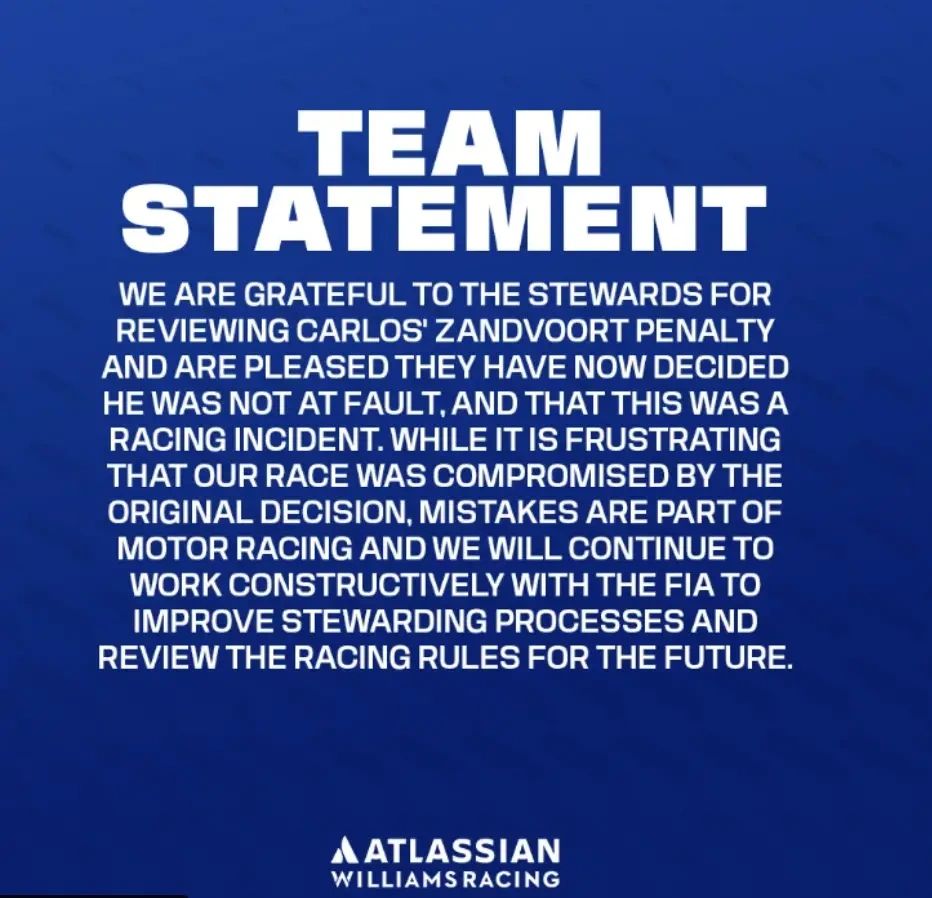
Williams released a short statement after the verdict, thanking the stewards for reconsidering the case.
“We welcome the decision of the FIA Stewards to overturn Carlos’ Dutch GP penalty following the Right of Review hearing. The new evidence demonstrated the incident was a racing incident and we are pleased this has been recognised.” Read the full team statement on williamsf1.com.
Want more Formula 1 coverage?
Dive into race reports, driver market news, and technical analysis in the Coffee Corner Motorsport F1 Hub.
Share the story. Grow the community.