


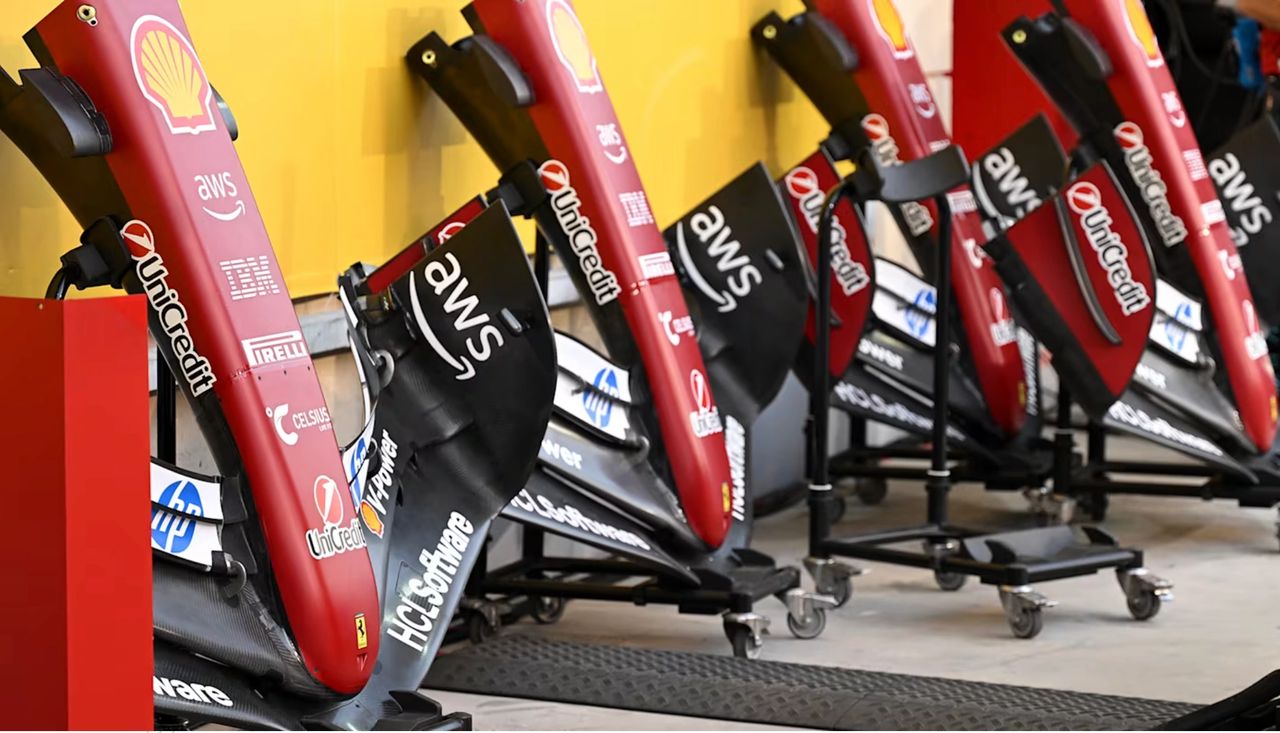
Ferrari’s Spanish Grand Prix was nearly over before it began. In a quiet but critical development on Friday morning at the Circuit de Barcelona-Catalunya, the Scuderia was forced to change its front wing design following a compliance check under the FIA’s new Technical Directive TD018. The issue wasn’t a broken part or a blatant rule breach — it was a case of one part of the front wing flexing more than allowed, just enough to fall foul of the FIA’s updated 2025 guidelines under TD018.
🛠️ TD018: A New Standard for Wing Flexibility
To most fans, it was just another technical directive — but for the teams, TD018 meant a fundamental rethink. Issued by the FIA to come into effect just before the Spanish Grand Prix, it signalled a hard stop on aero components that bend under load to gain performance, even if they pass older-style tests.
TD018, introduced by the FIA ahead of the 2025 Spanish Grand Prix, wasn’t just a minor adjustment — it represented a fundamental tightening of the rules around flexible aerodynamics. Its key provisions included:
✅ Reduction in Maximum Allowable Deflection
- Old limit: 5mm under a 60N load
- New limit: 3mm, applied at multiple new points, especially on flaps and outboard sections
The test also inluded when a 100KG load is applied symmetrically to both sides of the car, the vertical deflection must be no more than 10mm, and when applied to only one side of the car, the vertical deflection must be no more than 15mm.
This change significantly narrowed the margin for teams relying on small-scale, controlled flexing in specific aerostructures.
🔧 Expansion of Testing Criteria
In addition to traditional vertical load checks, TD018 introduced a wider range of tests to simulate real-world aero forces more effectively. These included:
- Multiple load application zones across various areas of the front-wing assembly
- Torsional (twisting) deflection testing to assess structural stability under yaw or asymmetric loads
- Off-axis and yaw-simulated forces are designed to replicate the conditions experienced during cornering and under crosswind pressure.
These new criteria tests were designed to prevent components that passed static deflection tests from flexing significantly under dynamic racing conditions.
⚠️ What the FIA Found on Ferrari’s SF-25
Ferrari’s SF-25 initially failed a TD018 compliance test during routine pre-session scrutineering on Friday morning. The FIA applied load at one of the new test points introduced by the directive and objected to an illegal deflector on the new (Ferrari) front wing— likely on the upper flap or endplate junction —after discovering that the element exceeded the new 3mm deflection limit.
While the component may have passed traditional vertical and static load checks, it did not meet the revised tolerance under the more comprehensive torsional and off-axis tests. This made the wing legally unusable under the current regulations and placed Ferrari at risk of disqualification from qualifying had the part been used.
🔧 Ferrari’s Technical Response: Emergency Wing Revision
Ferrari’s engineering team immediately set about changing the part to comply with the FIA findings.
The updated part was swiftly tested during FP2 and subsequently cleared through scrutineering by FIA officials before qualifying.
Both Charles Leclerc and Lewis Hamilton were permitted to continue without penalty, as the original component had not been used in any competitive session. Although these issues could well explain why Ferrari were concerned going into Free Practice about performance as well as explain some of the set up difficulties the drivers faced and complained about over the weekend.
🌟 A Clean Weekend After the Scare
- Leclerc finished P3, capitalising on race pace and a mid-race Safety Car
- Hamilton came home P6, showing improved consistency
Ferrari moved up to P2 in the Constructors’ Standings with 165 points, though well adrift of McLaren’s 362-point total.
🔬 What This Means for Ferrari
This incident highlights Ferrari’s aggressive aero philosophy in 2025 — and its risks. The SF-25 features:
- High sensitivity to ride height and front-end load distribution
- Aerostructures that previously relied on controlled flex to boost performance at high speed
- A narrow mechanical balance window, leading to frequent underbody wear and poor kerb stability
The Barcelona intervention demonstrates that even structurally legal designs can fall prey to regulatory evolution. Ferrari now faces the challenge of maintaining aerodynamic efficiency while building greater rigidity into future wing and floor upgrades.
🌟️ Eyes on Montreal
With TD018 now fully enforced, Ferrari heads to Canada needing not just speed but regulatory confidence. Their updated wing passed its first real-world test in Spain. However, with tighter oversight now the standard, Montreal will demonstrate whether Maranello can continue evolving without crossing the line.